
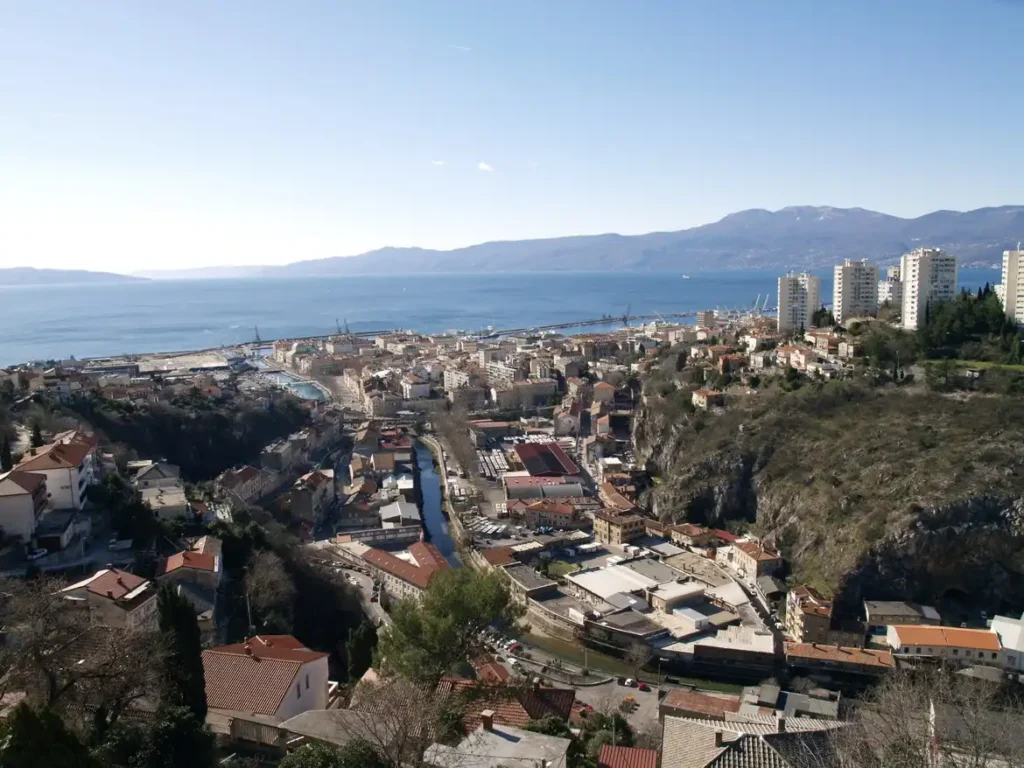
The subtle aroma of sea salt fills the air as the first rays of sunlight dance across the vibrant facades of Rijeka’s bustling port. As day breaks, the city’s lively promenade hums with the chatter of locals and visitors alike, entranced by the historic charm surrounding them. Despite being Kvarner’s largest city, Rijeka was, until recently, less popular with tourists than Opatija, Lovran, and Crikvenica. Even with Kvarner Bay’s beautiful islands, Rijeka remained less well-known. But this is changing.
Before I begin this simple guide to Rijeka, let me first explain that Rijeka means “river” – and that detail feels less like coincidence and more like a quiet explanation of the place itself. The river Rječina – Rečina flows down from the slopes beneath Trsat hill, cutting its way through the city before gently meeting the Adriatic Sea. It is this natural thread of water that gives Rijeka its name and shapes its rhythm, as if the landscape itself is always in motion, even when the streets feel still.
In recent years, more and more travellers have begun to notice this layered coastal city — its hidden corners, its working-port energy, its unexpected softness. And as they do, they share it onward, carrying pieces of Rijeka into conversations, photographs, and memories long after they leave. As a result, Rijeka is no longer known only for its port and carnival, but is now recognised as a vibrant city, similar to other central European destinations, full of museums, galleries, churches, and cultural landmarks.
Why should you visit Rijeka?
Rijeka (it. Fiume, the Italian name for the city, derived from the word meaning Rijeka, or simple “river”) was awarded the title of European Capital of Culture (ECC) for 2020. Coincidentally, this recognition occurred during the first half of Croatia’s EU Presidency. In addition to being Croatia’s largest port, Rijeka was positioned as a cultural hub, hosting performances by top artists from Croatia, Europe, and beyond. However, due to the Coronavirus pandemic in 2020, the year Rijeka held the ECC title, many planned events were cancelled.
This disruption was deeply felt by artists and locals alike. One such artist was Ana, a promising young contemporary painter from Rijeka, who had been preparing for her debut international exhibition scheduled for April 2020. The pandemic forced a postponement, leaving her feeling uncertain about the future of her art career. Yet, Ana found solace in the resilience of the Rijeka community, as virtual platforms became a new stage for artists to share their work with the world.

In the imposing city of Rijeka, the European Capital of Culture (2020), you will be delighted by something new with every visit. As the city’s name suggests, Rijeka flows like a river. And it is in the right sense of the word, connecting not only passers-by who wander through its cultural streets but also the sailors who leave, sail, and return to its port.
In Rijeka, you just can’t get lost. There are signs on every corner, leading the way to all its prominent attractions. As the largest city in Kvarner Bay, Rijeka effortlessly blends urban sophistication with beautiful Adriatic surroundings, offering tourists a chance to explore its rich history, vibrant culture, and diverse cuisine. ‘Central Europe’s Seaport of Surprises,’ Rijeka maintains its Central European authenticity while adding a touch of industrial charm.
We have prepared a lot to do in Rijeka. These include visits to museums and galleries, among many other activities. I like Rijeka because there’s always something new happening, and you’ll notice its vibrancy at first glance. Rijeka in Croatian means “river,” and Rečina (the augmentative) really flows through the town centre to the sea. I recommend you visit museums or have a coffee at Korzo, in honour of this cultural area recognised as European Capital of Culture in 2020.
See Rijeka sights
It’s only enough to start exploring Rijeka, and you’ll notice that strolling all the passageways of this multi-cultural city is nowhere near enough time. I’ve been making a selection of places to visit while in Rijeka, so here’s a shortlist of things to do. Step up to Croatian everyday life, interact with locals over a cup of coffee on Korzo, or a night out on Rijeka’s bustling promenade, shop on the vibrant central market like a genuine Rijeka. So let’s explore Rijeka and feel like “Fiuman”, as the locals are named.
See Trsat Fort and enjoy the best view of Rijeka
Since my visit to Rijeka, I recently returned to Trsat Castle—my second visit, the first being a childhood memory. Standing beside the Rečina Gorge atop this steep hill, it’s easy to understand why this spot was valued as a lookout in ancient times. Long before the Romans arrived, the Illyrians, who ruled much of the Balkans, had built a watchtower or fort here at the fortified site of Trsat.

During the 1500s, the castle changed hands between the Venetians and the Habsburg Empire. For a time, it was abandoned—until the 19th century, when it became the birthplace of Field Marshal Nugent, an Irish general in Austrian service (certainly a complicated era!). Today, the highest peak bears Nugent’s romantic touches from the late 1800s, though those are just a part of the story. Because once you climb to the top of the fortification, the true reward is the view. From up here, Rijeka spreads below you like a living map, while the Kvarner Islands of Cres and Krk dot the sparkling Adriatic beyond. On a clear, sunny day, the mountains of Gorski Kotar rise in the distance, a dramatic backdrop to the city and sea alike.
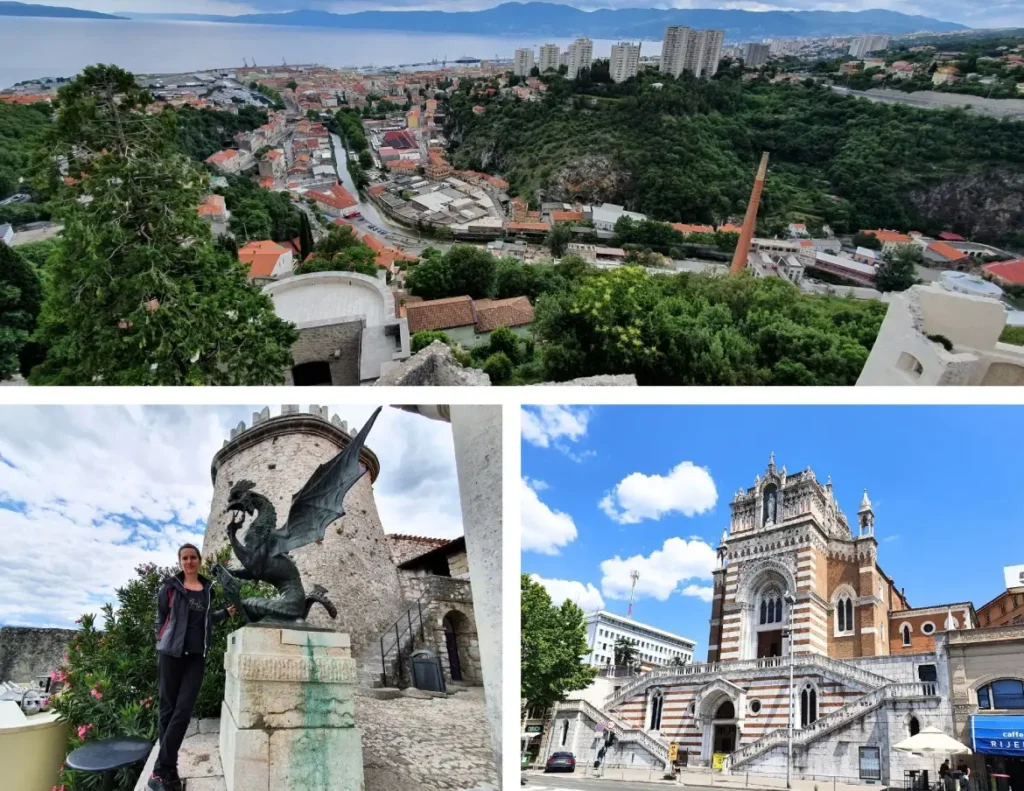
I like to reach Trsat by climbing over 500 steps—the “Stairs of Petar Kružić.” You’ll notice them easily near the bridge at Delta, spanning the Rečina riverbed. From the centre of town, the climb begins at the foot of the hill, winding up past Our Lady of Trsat, one of Croatia’s oldest Marian shrines, and onward to Trieste’s Tower. Since discovering this path, it has become my favourite way to reach the castle, though there are other options. A road climbs from the same starting point; if you prefer to drive, a taxi can take you to the top in just five minutes. No matter how you arrive, Trsat Castle is a must-see—a place where history, views, and the joy of climbing converge.
Shrine Of Our Lady of Trsat
One of the Trsat hill point features is the church of St. Mary. A Baroque Church lays claim to having once been home to Mary of Nazareth’s house (1291). She is said to have been carried here by angels. Since it was relocated to Loreto, Italy, Mary’s house is not in the church today. A church’s interior grounds are decorated with candlelight. This is why the locals come here daily to light candles and say a prayer. Candles can be purchased on site.

The beginnings of the shrine and the church date to the 13th century, while the church, in its present Baroque form, was built in the 17th century by the Frankopans. This is the oldest Marian Shrine in Croatia, and it attracts the largest number of pilgrims in Western Croatia each year, hosting one of the biggest processions in Croatia (update: follow the Covid-19 measures in Croatia for group gatherings). Outdoors, you’ll find a lush green park with seating and the statue of Pope John Paul II. The statue was erected in honour of the Pope’s 2003 visit to the shrine. A great place to sit if you decide to walk up the 500+ stairs (approx 20 mins). Beyond the park is a hill with Stations of the Cross.
Central Market
As it is a large traditional area of fruit, beans, cheeses, and local items like lavender and sage, the central market is a must-visit and almost every time I visit the central market when coming to Rijeka. The vibrant stalls, bursting with an array of colors from fresh produce to handmade crafts, offer a feast for the senses. As you weave between the stands, the air is filled with the earthy aroma of fresh herbs and the sweet scent of ripe fruits, while the lively chatter of vendors bargaining over prices adds a joyful hum to the atmosphere. Adjoining this market are two smaller pavilions where you’ll find meat, milk, street food, and much more.
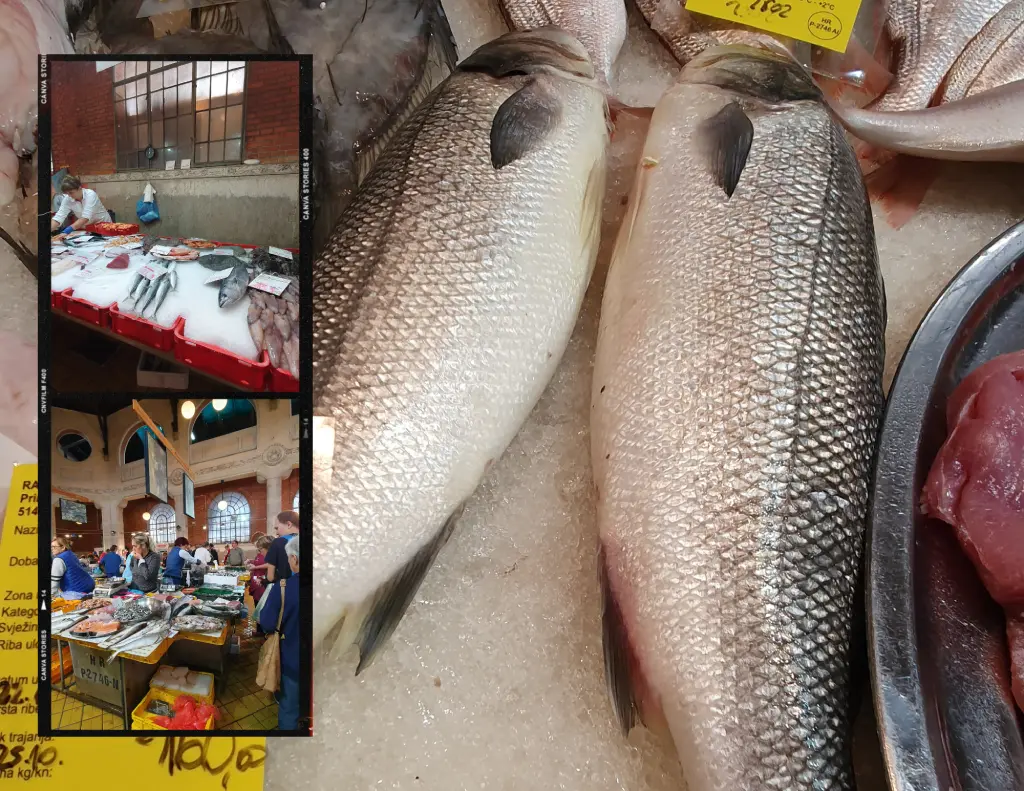
Furthermore, underneath, you’ll be surprised by the Rijeka fish market. The covered space inside the city market, Fish Hall Rijeka, features stunning Art Nouveau architecture in metal and glass. It was built in 1916 on the site of an earlier neoclassical structure, whose grand entrance is still in use. Upon entering, you’ll notice a wide variety of wild fish from the Adriatic Sea. Once you find some freshly caught fish from the Adriatic Sea, head up to your Kvarner accommodation and prepare a lunch meal or a party. Visit the city market with its Fish Hall and prepare the fish meal; it’s a must-do while in Rijeka, both for the full Kvarner experience and to stock up on fresh produce.
Korzo Street
This street is essential if you want to feel the vibrancy of everyday life in Rijeka. One of my favourite things to do in Rijeka is to stroll Korzo, a long, broad promenade lined with moderately priced shops and cafes. You could just sit with a cup of coffee or ice cream at a table there, and watch the world pass by. Picture an elderly grandmother slowly making her way down the street, pausing to greet friends and share a laugh, while buskers fill the air with lively tunes. Korzo, the beating heart of the city, stands as the centre of the city’s pedestrian zone.
As the day turns to night, Korzo takes on a more energetic, youthful feel, and you can see couples heading out for dinner, while some bars transform into nightclubs.
City Tower Clock
Photography fans will like Baroque City Hall, which is perhaps the most emblematic building in the region. Situated right in the Korzo centre, this is a sight you should not miss. The iconic yellow city tower, which was initially a bridge from the river to the old town, is one of the few buildings that witnessed the 1750 earthquake. After the tragedy, the Habsburgs introduced Baroque designs, including a portal with the emperor’s coats of arms and busts. In 1873, a clock was installed. It still has its original look, and you shouldn’t miss it since it is one of the prominent Rijeka landmarks.
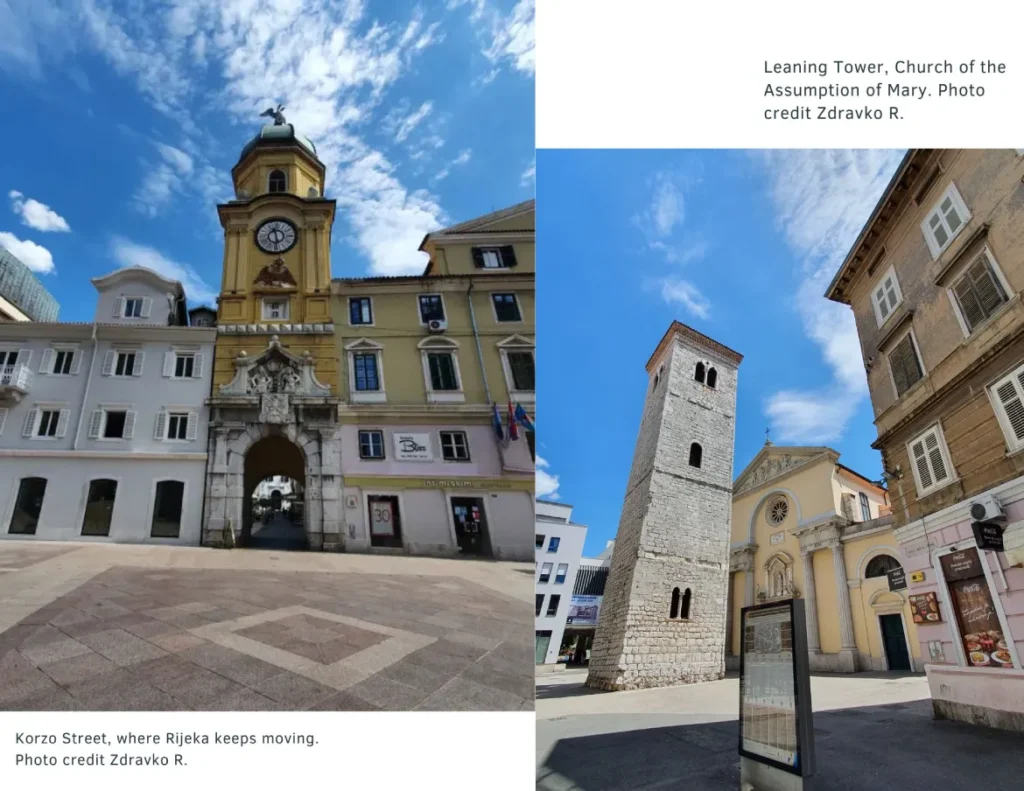
The front of the tower is adorned with a stone relief of the Rijeka double-headed eagle coat of arms, granted to the region by the Habsburg emperor Leopold I. You will very quickly find that the eagle is holding an overflowing urn between their hands. The same betrays the city’s constant loyalty to the Austrian government at the time. The front of the clock, behind the coat of arms, has been untouched since the 1600s.
See The Croatian National Theatre Ivan Zajc
After you’ve visited the city throughout the day, a good idea is just to attend a performance for the evening at the Ivan Zajc Croatian National Theatre. Opened in 1885, the city’s first light bulb illuminated this grand theatre, long before the larger community became linked to electricity. This elegant neoclassical architecture may not be out of sight in Rijeka, as one of the great Central European medieval towns. And you won’t be surprised to learn that the Viennese architects Fellner and Helmer designed its structure in the 1880s. The theatre’s official name honours the Croatian composer Ivan Zajc, known in the late 19th century as the Croatian Verdi and one of the world’s most prominent cultural figures.
The National Theatre, featuring dance, plays, opera, ballet, and theatre, is a multi-use venue. The shows should be in either Italian or Croatian, but the most prominent is seeing that in itself. It’s the building and its interior. Make sure to look upward, because the ceiling features are very early frescos by Ernst & brother Gustav Klimt.
Adress: Uljarska ul. 1, 51000, Rijeka
Putokoza local Tip: When you’re heading to Rijeka, you may want to search the website and see if anything is tickling your imagination. Pre-booked tickets must be purchased online before entering the Croatian National Theatre Rijeka Ivan Zajc. However, theatre lovers will enjoy the other theatres in Rijeka: Rijeka City Puppet Theatre and Rijeka Theatre.
Rijeka City Puppet Theatre
Founded in 1960 as Domino, the theatre adopted its final name, Puppet Theatre, in 1993. Since 1996, the renovated 180-seat building has hosted literary heritage activities for preschool and schoolchildren, both local and international. GKL Rijeka does not cultivate a specific puppetry technique, but each new title defines a practical puppetry term.
Adress: Blaža Polića 6
Pass the Old Gateway or Roman Arch
Locals have long claimed that this archway in the middle of Rijeka is an ancient Roman triumphal arch. Still, it was, in reality, part of the entrance to the former Tarsatica complex. Actually, the late-Roman defensive fort was later built in Rijeka. It’s the oldest heritage item on contemporary Rijeka streets. It has been merged between Korzo and the Cathedral by the “Ulica Stara Vrata” buildings on both sides. To fully appreciate its rarity, consider that this archway is a unique feature, akin to renowned Roman gateways such as the Arch of Titus in Rome, offering a historical link across the centuries.
Pass through the arch and take beautiful street photography. It looks stunning. Isn’t it?
Visit Modello Palace
The Modello Palace is another ornate Austro-Hungarian structure in Rijeka that will appeal to culture buffs. Situated in today’s Brajdica, Modello Palace was built between 1883 and 1885. Its design was based on the ideas of Fellner and Helmer. The same architects designed the National Theatre, Ivan Pl. Zajc. Those were responsible for hundreds of structures in the empire during that period.
The palace was built on the site of the demolished Adamić Theatre. It was initially intended for commercial and residential use. Giovanni Ciotta, the mayor of Rijeka at the time, was responsible for constructing the Modello Palace. A memorial to him was made in 1897 by Pietro Zambo. The monumental palace stands out with its elegant stucco façade. The building, characterised by Baroque and Renaissance neo-style elements, is rich in sculptural reliefs, two-storey pilasters, Corinthian columns, and dormer windows. Inside, there’s a gala hall filled with a variety of materials, including marble, stucco, panelling, gilding, and cast iron. The interior was previously used by Rijeka’s Italian Cultural Club, while the ground floor is Rijeka’s public library.
St. Jerome’s Church and Dominican Monastery
The Church of St. Jerome and the Dominican Monastery are some of the few preserved cultural and historical attractions. The buildings were built by the Duke of Devin’s dukes in 1315 to serve the Augustinians. However, the buildings were completed by their successor, Baron Walse. He finished the construction in the 1st half of the 15th century.
Next to the eastern cloister is the Holy Trinity’s votive chapel, which is today a sacristy. It was erected in 1450 by Rijeka captains Martin Raunacher and his wife, Margaret. Their coats of arms are displayed on the consoles at the chapel entrance. The remains of frescoes on the Gothic ribbed vault testify to the influence of the Gothic cultural circle. The next, the Chapel of the Immaculate Conception, located along the northern branch of the cloister, was built by Rijeka’s captains, Gaspar Rauber and his wife, Katarina, in the early 16th century. These two buildings are considered the most revered Gothic monuments in Rijeka.
A single-nave Gothic church was constructed after an earthquake in 1759 and extended to the west. Its interior and main façade were redecorated in a baroque style. It is adorned with a monumental main altar by the sculptor Antonio Michelazzi, dating to 1744. The altarpiece “The Virgin with St. Jerome and St. Augustine” is a high-quality work by an unknown author, dating back to the end of the 17th century. The domestic painter Ivan Krstitelj Cosimini’s valuable work, the “Deputation of Shepherds” from 1687, is valued as one of the numerous paintings in the Dominican monastery collection. In the monastery cloister, 23 sepulchral slabs of Rijeka’s patricians are embedded along the perimeter.
The Capuchin Church of Our Lady of Lourdes
According to the engineers Giovanni Maria Curet and Cornelio Budinich, the building, built from 1904 to 1904 and completed in 1929, represents a modestly conceived neo-Gothic structure. The symbol of “Žabica” would be noticed at a glance by every traveller arriving at Rijeka by bus. The church’s facades, what we see today, and the altar were decorated by the Venetian sculptor Urbano Bottasso and Rijeka’s carver Antonio Marietti. In contrast, the shrine was decorated with polychrome stained glass. The frescoes inside the interior were painted by the famous Rijeka painter Romolo Venucci.
The 75-metre-high lighthouse on top of the church should be built there. Still, it has never been built, so, unfortunately, I cannot tell what the view from it looks like, since it doesn’t exist. Only I can tell you to imagine it while you look at the church. Even though the lighthouse was not built, the church has become the right signpost for all travellers.
See the only round Cathedral in Croatia – Cathedral of St. Vitus
One will quickly recognise this Baroque Cathedral from the 100 Kuna banknote. It is quite famous for many purposes, but mainly as the only Baroque rotunda of monumental proportions built on Croatian soil.
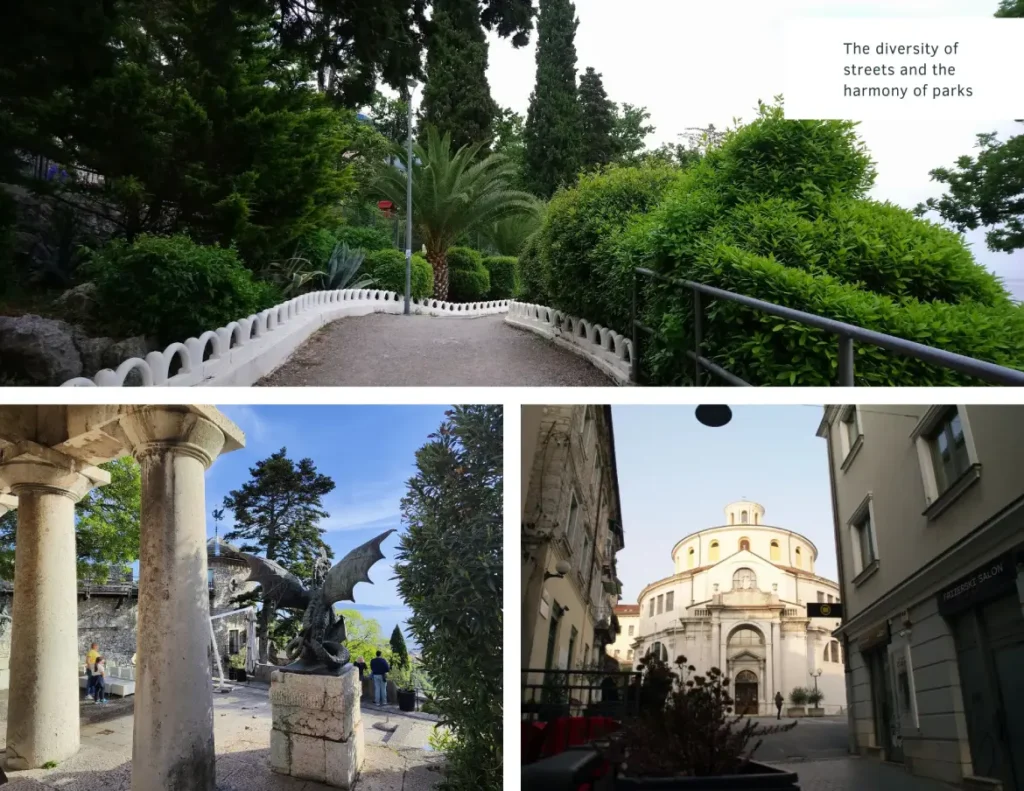
The construction of this church was based on the famous Venetian church of Santa Maria Della Salute, and was designed by the Jesuit architect G. Briano. It began in 1638. It has taken over 100 years to build. Initially, on the location where we see today’s church, a small church of the same name was dedicated to the city’s patron saint. There is also a hidden legend about it. The Miraculous Crucifix started bleeding while a certain Petar Lončarić threw a stone at it, with rage over a gambling loss.
Interior lovers will enjoy, since the church is a true baroque “Gesamtkunstwerk”, a synthesis of the arts. Don’t miss visiting it, as you will also find a portrait of St. Francis Xavier, the patron saint of tourists.
Palace of Justice
Constructed in the early 20th century in mainly Art Nouveau style, today’s Palace of Justice looks very impressive on the site of an ex-feudal castle. It presents monumental rustic buildings in places, even with stylised “cannon holes”. It was designed by the Budapest-born architect G. Czigle, with support from architect G. Rubinich, and both architects maintained the masonry style.
Walk across the Breakwater
You simply cannot visit Rijeka without experiencing the allure of its 1707-meter-long breakwater promenade. Known locally as “Molo Longo,” it serves as both a passenger terminal and a beloved walkway. Imagine the ambitions of its builders, who, inspired by the vision of Empress Maria Teresa, set out to create this architectural marvel. Constructed by a Parisian railway company under the guidance of Hungarian architect Antal Hajnal, the breakwater was completed in 1888, with construction plans dating back to 1872. Over the years, it has withstood the fierce embrace of the Adriatic’s storms, standing resiliently as a testament to the city’s enduring spirit and the powerful forces of nature it was built to defy.
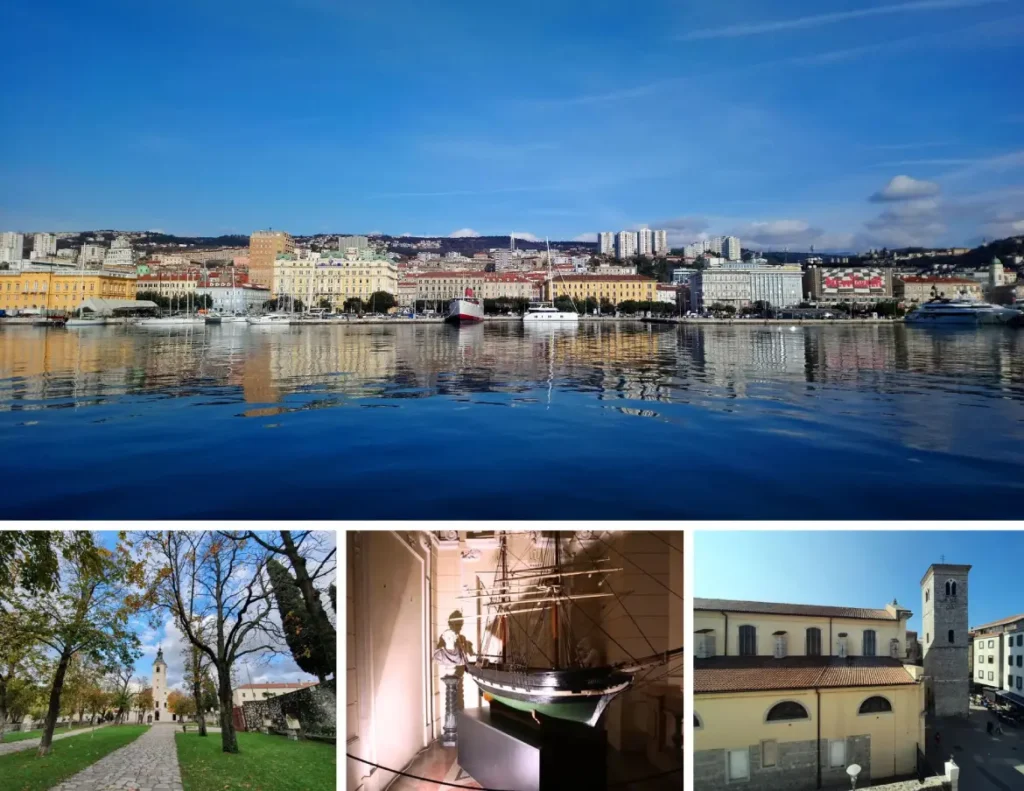
In the 20th century, the Breakwater was enlarged. A pier used to close the Breakwater was erected in 1908. The final enlargement to the Breakwater was constructed in 1934. During WWII, a range of diversions were conducted at the Rijeka Port, which was damaged during the German retreat in May 1945. After WWII, as Rijeka underwent new development, mostly based on industry, pride was placed in restoring the breakwater cranes. Take a walk, watch the Adriatic Sea and the island of Cres, find a coffee shop and take a coffee or your favourite drink, while enjoying sitting on the waterfront.
See Peace Ship Galeb
The ship, visible from the waterfront near the city market, is both a symbol and a witness to the political and social history of the 20th century. The ship Galeb (meaning “Seagull”), also known as The Peace Ship Galeb (Brod Mira, Galeb), was designed and launched in 1938 at the Ansaldo Shipyard in Genoa, Italy. Originally built as a cargo ship under the name Ramb III, it was repurposed as a warship during the early stages of World War II, initially serving as a battle cruiser. Following Italy’s capitulation in 1943, German troops took command of the vessel, renaming it Kiebitz and equipping it with tracks for launching mines. The Kiebitz laid over 5,000 mines in the Kvarner Bay and northern Adriatic before being sunk by Allied bombs on 5 November 1944 in the port of Rijeka. In 1947, the ship was salvaged by the Brodospas company from Split.
After renovation at the Uljanik shipyard in Pula, the vessel was commissioned as the Galeb School Ship. In 1953, Yugoslav Marshal Tito made his first international voyage aboard the Galeb to London for a meeting with Winston Churchill. From then on, Tito used the ship as a floating residence, sailing across the world until 1979. During this time, the Galeb welcomed over 100 statesmen and women from around the world, covering more than 80,000 nautical miles. After Tito’s death, the ship was opened to visitors. In the late 1990s, it was sold to a Greek shipowner, but the vessel was never renovated due to the owner’s bankruptcy. In 2006, the Ministry of Culture declared the ship a cultural asset of the Republic of Croatia. The City of Rijeka purchased it in 2009 with plans to transform it into a floating museum, offering several rooms for overnight stays.
The company Dalmont was selected to carry out the renovation works, scheduled to begin in 2019. Once reconstructed and fully equipped, the Galeb will become a cultural venue in Rijeka. The ship is planned to host permanent museum exhibits, occasional exhibitions, a cinema, and creative workshops. It will also serve commercial purposes, featuring a hostel, bar/restaurant, and a souvenir shop, covering a total of 5,565 m².
Governor’s Palace
This is a brilliant white neoclassical palace from the late 19th century, constructed for the Hungarian governor Lajos Batthyány. It is probably one of the most stunning buildings in Rijeka. Construction of the Governor’s Palace began in 1892 during the governorship of Lajos Batthyány. The palace design was led by the leading Hungarian architect of the time, Alajos Haussmann, who had already proved himself on the King’s Palace project and the Budapest Parliament building.

A large, colossal Neo-Renaissance palace was constructed on a 12,000 m2 site, based on models of Palladio’s famous works, with a French park featuring two fountains, wrought-iron balustrades, and two-leaf doors with wardrobes. Today, the Maritime and Historical Museum of the Croatian Littoral, founded in 1961, is located at the palace.
Visit the museums, explore the culture & arts
Since it was awarded the title of European Capital of Culture (ECC), Rijeka has developed its cultural scene, so its museums are a precious resource worth exploring.
See Torpedo Factory & Museum
One of Rijeka’s many claims is that it was the birthplace of the torpedo. The tale goes that Ivan Lepps, a former naval officer, sought to develop ideas to protect Rijeka’s coast. He created the self-propelling “Coastal Saviour” in a moment of inspiration. He worked with British engineer Robert Whitehead to construct a prototype. They put their heads together and came up with the prototype “torpedo”; the first tests were made in 1866.
By 1943, the factory located on the western waterfront of Rijeka rolled out torpedoes at a rate of hundreds a month. More accurately, it reached its peak output of 160 submarines a month, but went into bankruptcy, and all that remains today is a shell of the old Torpedo–Launching Ramp. The town is now making proposals to rebuild the site, honouring its history.
However, the torpedo prototype can be seen at the Torpedo Museum in Rijeka, situated in the central part of Rijeka on Žabica, where the factory was located. This very specific museum is one of the few military museums in Croatia. A prototype of a torpedo could also be seen in the Zagreb Technology Museum.
Astronomical Centre Rijeka
This unique building, located in a renovated WWII-era military fortress on Sveti Križ Hill in an eastern suburb, is on the hill. It is the only one in Croatia that combines a planetarium and observatory.
It’s quite a recent attraction. Besides the astronomical significance, the project represents one of the most significant investments in Croatia’s technological culture. So far, the observatory has found 2 variable stars. The perfect time for visitors is on Wednesday evenings during the season, when the district-of-the-art planetarium shows films in several languages at 10 pm.
Since the centre holds numerous seminars, small events, workshops, and conferences, all astronomy fans will enjoy a visit. The Rijeka Astronomy Centre offers the possibility of hiring a conference room, a gaming space, the planetarium, and two terraces – one lower, in front of the building’s entrance, and one higher, panoramic, on the top of the building. Hire the patio and enjoy the fantastic view while you work or write the blog.
Peek & Poke Computer Museum
Whether you’re into retro machine hardware or not, this museum could be worth stopping by. A timely appeal is one of the very few permanent displays of vintage computing technology, located in the heart of Rijeka. Peek & Poke is a large set of controllers for playing with portable computers from the 1960s. And of course, individuals of all genders, from the Nintendo Wii and the Sinclair Spectrum, would find their favourites.
It’s amusing to see them in a personal computing chronology up close, to see too many of those vintage machines in working order. Visitors are still welcome to go on any of them and find a library of books and magazines from that era. After all of it is done, you can take a rest in the lounge area, so pushing yourself away can be challenging!
See the Carpathia lifejacket in the Maritime and History Museum of the Croatian Littoral – Povijesni i Pomorski Muzej
This attraction is set in one of Rijeka’s most stunning buildings, the Governor’s Palace, which we mentioned above. Established in the 1960s, the museum is managed by many departments: archaeology, ethnography, culture and literature, and maritime exhibits. It won’t be hard to spend a few hours in it, since you’ll have an excellent time researching extensive collections. Those are old coins and maps to coats of arms, antique weapons, navigational devices, toys and even postage stamps. Because this kind of museum is my favourite, I recommend visiting it if you decide to visit museums.
The fascinating item on display in the museum is the Carpathia ship lifejacket. The Carpathia ship had a line connection between New York and Rijeka when the RMS Titanic sank (15 April 1912). It sailed the treacherous, icy waters to rescue over 700 people from the Titanic. The lifejacket in the Maritime and Historical Museum of Rijeka is one of only four recovered from the Titanic. It is considered to be the only one in Europe.
Rijeka City Museum
Located in the Governor’s Palace yard, the building displays exhibits and artworks related to Rijeka and its history. First mentioned in 1875, the City Museum of Rijeka opened in 1893 and is known as Museo Civico. However, the modern museum we see today was founded in 1976. Art and history exhibition lovers will find themselves looking at items that best showcase Rijeka’s history and culture through artistic observation.
Natural History Museum
In addition to the botanical garden, the museum is an interactive facility with an aquarium featuring Adriatic Marine creatures. The museum also houses insects, reptiles, birds, amphibians, fish, sharks, and sea rays—ideal programming for kids and adults alike.

Museum of Modern and Contemporary Art
Art buffs would have a lot of fun at this museum, which collects works by artists. The artificials include collections of paintings, sculptures, drawings, prints, posters, photographs, new media art, film and video, and specialised collections. They comprise more than 8000 works, created from the end of the 19th to the beginning of the 21st century.
Rijeka surroundings tours
Yet Rijeka is situated in the centre of the Kvarner Bay, surrounded by mountains of its land side and the stunning Adriatic Sea with its islands on the other side. There are significant opportunities for outdoor tours.
Here are a few ideas for places to visit while in Rijeka. Almost all of them are tourist attractions in their own right.
Fill Fabulous in Opatija
The fabulous Opatija, as Croatian singer Ivo Robić said in its song “Serenade to Opatija” (edition 1949 – 1953), is honoured by it, as the song says it is stunning and beautiful. Situated in the centre of Kvarner Bay, an elegant spot friendly to families with children, couples, and even single travellers, is considered the “oldest lady of Croatian tourism”.
With the stunning, illuminated 12-km-long coastal promenade known as the “Lungomare” sea promenade, Opatija has, aside from achieving touristic development in the 20th century, remained in complete harmony with nature right up until the present day. It’s of well-maintained public gardens, well-kept beaches and fountains. An area provides a stunning backdrop for the villas and hotels that can accommodate up to 6.000 guests. Many of them are from the Austrian impact.
Lovran
This picturesque place, with a long and diverse past, has a century-long tradition of tourism. It has been developed on the steep eastern slopes of Učka. It is considered the oldest one, founded directly on the coast of Liburnia. Because of its preserved historical core and Old Town, filled with courtyards and a water well at its centre, Lovran possesses the unique charm of Mediterranean townscapes.
With a mild climate and luxuriant Mediterranean vegetation, Lovran is vibrant, with its colourful façades. Most of them were decorated with steps, porches, and vaults, framed by stone gates. Eventually, the stunning sea promenade in Lovran is a spot you should not miss while in Kvarner.
Grobnik castle
One of the best-preserved testimonies of the past is undoubtedly the Frankopan Castle, situated on a 466-metre-high hill between the left bank of the Rječina River and the Grobnik Field. Besides being a historical fort, it offers stunning views. Enjoy the view that extends to Krk, Cres, and Učka to the northwest, and to the Grobnik Alps to the northeast, and you’ll notice how strategic that position once was.
Kostrena
This old seaside town was first mentioned in the early 15th century. Situated next to Rijeka and surrounded by Martinšćica and the long bay, Bakar would be a favourite spot for history enthusiasts. There are 20 settlements, many of which are named after the families who once inhabited them. The area is characterised by karst.
Novi Vinodolski
Situated in the central part of the northern Croatian Littoral, the city has developed from an old fort. The fort used to belong to the noble Frankopan family. Simultaneously, the old part of the town is characterised by typical Mediterranean littoral architecture. The area, amidst various stone buildings with white façades and red roofs, gently rises from sea level up the hill, where the church and the tower seem to watch over their surroundings.
Besides plenty of cultural heritage, the thorp, free of industrial pollution, is surrounded by a crystal-clear sea and shore. It’s bounded by numerous vineyards, while the fresh mountain breezes blow gently from the woods into the town. The immediate hinterland, not far from the North Velebit National Park, is an ideal location for daily tours or a holiday.
Smell aromatherapy on Lošinj
Lošinj Archipelago includes the large, wooded Lošinj, fertile Unije, flowery Ilovik, sandy Susak, and several attractive smaller islands, rocks, and reefs, making it among the most stunning locations in Kvarner. All those who seek tranquillity, nature, aromatherapy, outdoor paradise, and past traces should stop here.
Ičići
Situated close to Opatija and once a crucial timber shipping port, Ičići is a small place today famous for its nautical centre. It’s an exciting step for all those looking to drive along the Kvarner Bay from Rijeka to Istria.
Mošćenićka Draga& Mošćenice
Situated practically at the end of the coastal road from the Rijeka direction to Istria, it seems to be a little “separated” from the rest of Kvarner. Still, for tourists, curious visitors, weekend guests, hikers, sportspersons, artists and nature enthusiasts, this place has always been the favourite destination.
What will surely be a real discovery for everyone is the picturesque place Mošćenice, situated on the hill above Mošćenićka Draga and bearing the same name. The view from Mošćenice is very magical, as is the whole place. You’ll see the small, narrow streets, filled with the breath of the past. Yeah, it looks like a great idea to write a blog story dedicated just to Mošćenice, right?
Find the Legend about Kvarner Bay in Medveja
Full of picturesque, small and beautiful sunsets, the once-typical fishing village of Medveja has remained peacefully in its surroundings over the years. It is one of my favourite places, and I gladly stop there every time we go hiking on Učka or drive towards Rijeka on this side of the coast. In Medveja, not far from the sea, there is a beautiful climbing spot, making Medveja a favourite of climbers.
Medveja was named after the mythological Greek sorceress Medea. She was the first person to enter the sea from its beautiful and spacious pebble beach. It is said that the Argonauts, the forerunners of the nomadic life, which characterises most travellers in search of the golden fleece, entered the sea into the Gulf of Kvarner. At the mouth of this legend, here in Kvarner, the victim was the not very well-known hero Apsyrt, whose dismembered body parts Medea threw into the sea. And yes, that’s precisely the way the Kvarner archipelago was created.
Viškovo
First mentioned as early as the 16th century, it’s undoubtedly distinctive for its road, which is among the oldest streets in the Kastav area. It was the only road connecting Rijeka, Trieste, Ljubljana, Graz and Vienna. Drive yourself on its road and find the reason it was so meaningful.
Jelenje
Only 15 kilometres from Rijeka, in a karst area at an altitude of around 300 meters above sea level, is the main reason you should make a trip or holiday to this Mediterranean-continental climate place. Jelenje is a little but is famous for the tradition of its milkmaids (“Mlikarice”). Those are women who have historically carried milk daily to sell in Rijeka. A special event, “A Lantern that has left its mark” (Croatian: “Feral ki Je Pušćal Sinjal”), has been dedicated to them and held every May. Go up and taste some fresh milk!
Cres
Every time I go to Cres, I want to return twice as much. Located in the wide Kvarner Bay, Cres is considered the largest Adriatic island and has several climatic and vegetation zones. The island boasts a rare natural phenomenon – a freshwater lake in the island’s centre (Vrana Lake. Not only for outdoor fans, such as Putokoza, for which Cres is a paradise, but also for all those who like to enjoy a charming Mediterranean vibe, Cres will be a revelation.
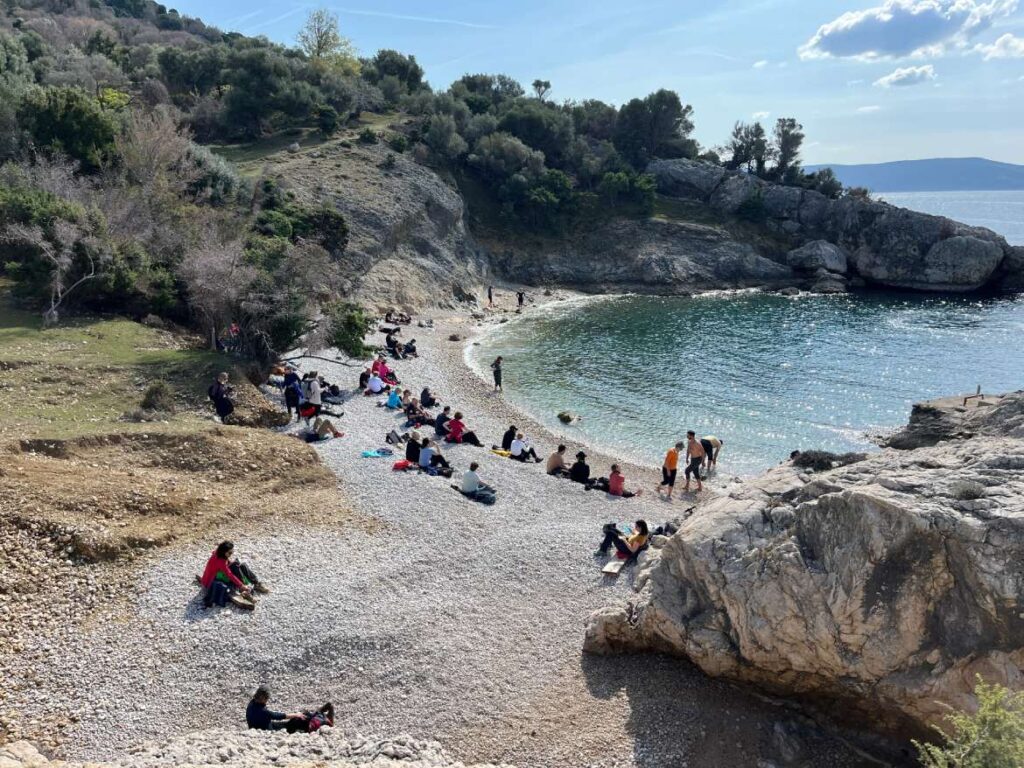
I found out on the Tramuntana trail, my daily hiking tour, that it already started with the ferry from Porozina harbour. The course is ideal for a day trip from Kvarner or Istria, departing from Porozina, without paying a car fee. Since I discovered it, it has become my hobby once a year.
The midpoint of the trail is picturesque Beli. A very scenic small town situated above the sea; it looks so mysterious and magical. Ok. It’s not real magic, but let me tell you, it is more than 4000 years old. However, it’s not certain that it’s the only one on Cres, since there are a few similar towns on the island, such as Lubenice, Pernat, or the old main town, Cres. Sis (639 meters above the sea level), the island’s highest point, was for me no less of a discovery than scenic places. Almost everyone can do the climb to Sis, even with the children. The ruins on the peak provide evidence that Cres was populated already in the early Stone Age. So don’t wait. Take a ferry from Brestova to Porozina, a small port town located on the northwest coast of Cres, Croatia. Go to find some sheep, since there is no stress on Cres! Yes, Putokoza, like sheep, and we are thankful to share your Cres experience.
Kraljevica
Located at the entrance to the Bay of Bakar, right in the heart of the blue Gulf of Kvarner, small and picturesque Kraljevica is surrounded by the sea’s blue, the sky, and the green of luxuriant vegetation. In contrast to the natural surroundings, Kraljevica is rich in historical monuments. What I also suggest seeing is the scenic “Bakarac”. The photography lovers will enjoy the spots. Go and make some stunning photography to share with Putokoza.
Gorski Kotar
No matter how many times I come to Gorski Kotar, it will always offer an undeniable appeal in its preserved forest areas. The peaks, such as Snježnik or Risnjak, are picturesque, with valleys like Lazac, many crystal-clear rivers, and lakes like Lokvarsko Lake or Bajer. This is a region one would love to explore. Nature reserves; cultural monuments such as Bijele & Samarske Stijene (White and Samar Rocks), Bitoraj, Lokvarska Cave; rural, traditional values, and locals’ warm hospitality.
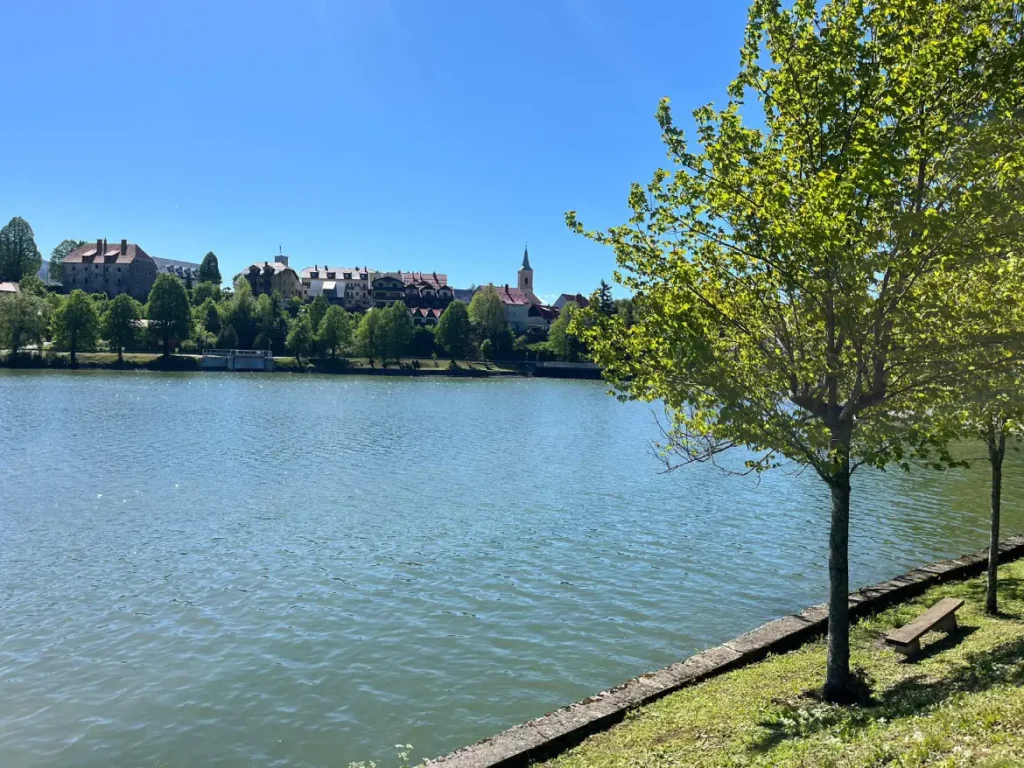
Nestled between continental Croatia and its coast, whichever Gorski Kotar tour you decide to choose, be sure you’ll enjoy it far away from the hustle and bustle. Each has its own story, full of small scenic places such as Fužine, Skrad, Delnice, Prezid, Gerovo, and Ravna Gora. All of them are surrounded by stunning woods, so in almost every corner of Gorski Kotar, you can listen to the sound of the wind. If someone asks me for a recommendation on visiting Gorski Kotar, I will tell them. Suppose the whole of Croatia is my first choice as a destination. In that case, Gorski Kotar is definitely one of my best alternatives, along with Istria and the beautiful islands of Kvarner. So don’t hesitate, especially if you’re a fan of outdoor sports. Head off and find some beer in the woods! We already did it!
Klana
Situated in the mountains that border the Gorski Kotar, Klana is a favourite destination for recreational walkers, hikers and cyclists. And not only for them, for Putokoza as well, since it is one of them! We like that there are well-arranged and marked biking and walking trails that, together with the historic attractions, make Klana an interesting and recommended stop on the Rijeka Ring. It is a place of beautiful nature and valuable historical monuments, so cyclists or walkers, let’s go.
Bakar
Situated in the north-western corner of the magnificent bay that bears the same name, Bakar is considered the oldest town in the Northern Adriatic. It is another place on Kvarner that I suggest you not to miss. With a long and rich history, famous for the Maritime School, Bakar is where the Mediterranean Sea soaks deeply into the European continent. The place is shaped in one of the most sheltered bays on the eastern Adriatic coast, which some also call a fjord.
Yes, we travelled to Bakar many times, and even I tried the sea for a Regatta with my rowing colleagues. Since the road to Šmrika and Krk from Rijeka has been made, I often miss Bakar, because the journey is longer. However, you shouldn’t miss it.
Istria
Because the Istrian peninsula is Putokoza’s home, and we write about it a lot, of course, I couldn’t miss recommending it on the tours you can do from Rijeka. Being the most prominent Adriatic peninsula and a region of unique blue and green landscapes, with a coastline of inlets, beaches, and small, picturesque historic towns, the word “Istria” itself shouldn’t be enough.
Istria has more stories, and you can choose your own. The first thing that makes the peninsula popular is its coastal, picturesque towns, such as Rovinj, Poreč, and Umag. Furthermore, the southernmost city of Pula, which has numerous impacts from Austria, last but not least, there are the picturesque central Istrians, surrounded by greenery. Yes, find some giant trails while stopping by in Hum, Oprtalj, and Motovun. But not only that. Istria is also a region with a gastronomic arm filled by sea specialities, the mighty truffle, homemade pasta, aromatic herbs and many other delicacies, accompanied by excellent wines and olive oils. Taste someone. Regardless of the spot you choose, the travel time from Rijeka will differ.
Crikvenica
In contrast, having plenty of opportunities to sunbathe, swim, walk, cycle or enjoy recreational sports reflects the valuable history. The cultural heritage, beautiful natural surroundings, crystal-clear sea, fresh air, and traditionally hospitable people all make Crikvenica ideal for balmy, stable, and healthy Mediterranean-climate seekers. Situated about 40 minutes from Rijeka,Crikvenica also offers events such as the traditional Fishermen’s Week (one of the oldest festivals in Crikvenica), the Aquarium, filled with more than 150 species of fish, and the ever-popular.
Krk
Located in the centre of the Kvarner Bay, also called the Golden Island – “Insula Aurea” – Krk is full of trails traced by the past. Krk is one of my favourite wander destinations. With the stunning Obzovi summit (570 m) as your backdrop, you’ll enjoy breathtaking views. Still, on the other hand, you might also forget that when you’re actually on an island, since it is often a very windy spot. The hidden coves, such as Mala & Vela Luka, with their sand, pebble beaches and rocky shorelines, are places you must discover while you’re on Krk. And they are full of sheep. Yes, Putokoza likes its friends. Go to find them and follow those uncovered traces.
Besides being an outdoor spot, Krk is also a historical island. It’s the place of the “Baška Tablet”, one of the first monuments containing an inscription in the Croatian recension of the Church Slavonic language, dating from c. 1100 AD. The charming places such as Stara Baška, Vrbnik, and Krk are only a few of the places I mentioned during my tour of Krk. The Island ofKrk is where you can look at the sky full of stars and know what else. Krk has almost become a peninsula since it’s connected to Rijeka by a bridge. It can be easily reached from Rijeka.
Učka
The mountain that borders Istria and Kvarner is one of the spots I visit a little bit less often than my home. Located along the northern Adriatic coast at one of the most northerly points of the Mediterranean, this park is a true nature paradise. Head along the thick woods, touch its streams flowing over their slopes or find shelter in some of the hidden convoluted trails alongside the mountain. But it’s not only that.
You probably didn’t know that Učka is the home of pixies. A few of my favourite tracks on Učka are Poklon’s, or, if the hiking mood is high, Medveja’s, which we mentioned. But Učka is not only for trailers; it is also rich in biodiversity. For all of you with small children, there is a marvellous children’s track near Poklon, so if you doubt where to run away from hustle and bustle, don’t think too much. Učka is always a choice that can’t go wrong.
Volosko
Once, Volosko was the district’s seat, an important trade port and the area’s administrative centre before Opatija was developed into a tourist destination. Although Volosko has lost that importance, it has retained its magical appeal as a picturesque fishing village. It is an ideal place to find peace and calmness. Yes, we like to walk along the Volosko and “Lungo mare” promenade on its waterfront. Just let yourself be drawn into the harbour’s unique atmosphere and enjoy the view of the entire Adriatic. If you stop by during the windy weather, the visit will be more charming, as you’ll hear the sound of the sea.
Senj
Although 76 km from Rijeka, Senj, the largest urban agglomeration on the Croatian coast between Rijeka and Zadar, is a lovely, picturesque small town. Every time I revisit Senj, I feel like I’m there for the first time. History buffs and lovers of remote, scenic places like me will love it for its location and historical significance. Located between the Kapela and Velebit slopes, overlooking the sea, Senj has been connected to the Mediterranean for centuries. This tiny town, situated at the base of Croatia’s largest mountain, once held great strategic significance. The most famous monument in it is the Nehaj Fort, and I suggest visiting the city for all kinds of travellers.
Due to its location on the Eastern Adriatic coast, it is linked with the hinterland by roads leading across the Vratnik pass (700m above sea level) in the north. The Vinodol Valley and Rijeka are also in the west, and Zadar, Split, and southern Dalmatia are in the south. Senj is our favourite stop, since we travel directly to Velebit for a hike, or to Rab or Zadar along the coast road, “Jadranska Magistrala Road.”
Kastav
Distant 10 kilometres up the coast from Rijeka, on high ground, the little stone town is situated at 365 meters above sea level. If you want to escape from Rijeka but see more of the culture, a visit to Kastav is worthwhile, as you can stroll its 16th-century streets. In reality, many locals come to Kastav during the summertime to enjoy many concerts and festivals held at this scenic location. There are a blues and a guitar festival, and the Kastav Summer of Culture that runs through the season.
Check the online sites and see what happens when you stop by. While in those views that go out to the islands of Krk and Cres, and down to Rijeka, you might only rejoice.
Be active in Rijeka surroundings
Hiking. There are practically unlimited hiking opportunities in the Rijeka area, as it is situated on the slopes of the Učka mountain. The other mountains are those of Grobnik and Gorski Kotar. Let me mention some of my favourite hikes here.
Putokoza Hiking Tip: Učka
1) From Lovran or Medveja (0 mt) to Vojak (1396 mt). This fascinating trail starts from the sea and rises to the Vojak summit. Because it requires good health and physical preparation.
2)From Liganj (24 mt) or Lovranska Draga (365) to Vojak (1396 mt). The trail from Liganj is practically the same as that from Lovran, even shorter. The route from Lovranska Draga is prevalent. It is one of my favourites since it passes through the very shady forest. You can choose the way to the nearby mountain hut Babino Sklonište, up onto the climb or back. The view from the mountain hut is stunning, overlooking Cres Island.
3) From Poklon (917) to Vojak (1396 mt). This is one of the most popular trails used by anyone who needs a good afternoon walk or to catch some fresh air. What I like to do is the circular route, and you can choose from other options. However, the trail was a bit steep in some sections, and it takes about 1.5 hours to the Vojak.
You can choose the sea, the quarter or the last quarter from the mountain. Still, whenever you decide, nothing compares to the breathtaking, spectacular view extending to the whole Istria and Kvarner with its islands.
4) Lovranska Draga – Draški Slap. This practical walk, rather than the hiking route, is ideal for families with children or holidaymakers. During the spring offers the possibility to enjoy its beautiful waterfalls.
Putokoza Hiking Tip: Hiking to Grobnik Alps. These beautiful mountains are located just above Rijeka. One of my favourite trails starts in the picturesque village of Potkilavac. It leads through the canyon of Mudna Doli or over the ridge above it. You can hike to the scenic small Hahlići Lakes, or, if you feel up to it, continue to the top of “Fratar Summit” (1353 m).
Putokoza Hiking Tip: Hiking in Gorski Kotar. Gorski Kotar is, as we already mentioned, full of trails. In the scenic Fužine, there are various routes one could take. My favourite one starts in the tiny village of Vrata and heads up to Bitoraj Peak. Another trail one could run is along Bajer Lake. The hikers would also enjoy Bijele and Samarske Stijene Peaks (1301 m). Bear in mind that Bijele Stijene nature reserve is deep in the woods; it’s a long drive to the start point and takes the whole day.
Putokoza Hiking Tip: Hiking trail “Platak“. There are numerous hiking options around Rijeka. But let me just tell you one of my favourites is the route from Platak to Risnjak, or from Platak to Snježnik via the “Guslica“ peak.
Putokoza Hiking Tip National Park Risnjak. National park Risnjak is a part of Gorski Kotar. Formed and filled by mountain air, surrounded by the natural forest, it will be a very relaxing therapy for all travellers. The most used trail to reach the Risnjak summit (1528) is from Vilje via Schlosserov Dom.
I like it because the trail is mostly in the woods. There is also the very interesting “Educational Trail Leska” inside of Risnjak. It’s very unique, and I recommend visiting it, as it is an excellent place to escape the hustle and bustle while in Rijeka.
Rock climbing. There are a few hidden locations to practice rock climbing in Gorski Kotar, but what I suggest is to enjoy a beautiful sunny day while you’re on vacation at the rock in Medveja. You can also take a drive to Istria, above Roč. All the routes are signed in the climbing guide.
Cycling. The surroundings of Rijeka offer a varied selection of bicycle paths. Below we will list just a few of the ideas.
Putokoza Cycling Tip: Kastav Wood. Starting in Kastav, this route leads through Jurdani, Mučići, Mučkov Vrh and offers a nice experience in nature.
Putokoza Cycling Tip: Ćićarija along the Veprinačka Cesta.This is my favourite in the Rijeka surroundings. The whole section is about 22 km from the road, but you can choose a shorter circular route. The forest passes across the hunting lodge, “Brdo”, belonging to LD “Lane” from Opatija. A few kilometres further, there is another similar house Lugarnica “Pilarna, belonging to the Opatija forestry. Use your bike map or the other app you like.
Paragliding. About 27 km south of Rijeka, a tiny village called Tribalj is where you can test your paragliding skills! If you don’t fear heights too much, then certainly try this unforgettable experience.
Diving. Kvarner Bay was created for discovery. You will find many diving tourism offers in it. There is no end, but sometimes we need to make one. Read more in our other articles about the outdoor experiences near Rijeka.
Go to the beaches
The bathing season in Rijeka runs from spring through late autumn, thanks to the Mediterranean climate. Along this stretch of the coast, there are beautiful beaches around Rijeka, two of which have earned the prestigious Blue Flag award. This accolade is granted to the best beaches in Europe, meeting stringent criteria for water quality, safety, and facilities. Both Ploče and Kostanj feature shingle bays with clear, crystal-blue waters that invite tourists to enjoy swimming and relaxation. There are numerous beaches, varying from large and lively to small and secluded, and they range from pebbly, concrete, rocky, to hidden stretches of land. Many of these beaches near Rijeka boast volleyball courts and water volleyball equipment, making them ideal for fun in the shallow sea.
Ploče Beach
The beach, surrounded by a floating barrier, provides disabled people with access to the sea, a rescue service, catering facilities, changing rooms, showers, sanitary facilities, and a garage. Since it has a beach volleyball court, it’s equipped for water basketball. Ploče has a complex of swimming pools for those who like them, and the most important is a Blue Flag beach.
Preluk Beach
Despite its position in the wind, which blows most of the day, this beach is a true windsurfing paradise. Since it has an entrance for smaller vessels from the land, it is suitable for yachtsmen. There are showers and sanitary facilities on the beach.
Kostanj Bay Beach
Another Blue Flag beach is the city beach, primarily intended for people with disabilities. The beach’s safety is very high, as the swimming areas are monitored by trained lifeguards. The beach is surrounded by a floating barrier. The beach is equipped for water basketball. In addition to sea access for disabled people, it has catering facilities, showers, and a sanitary facility suitable for disabled people. There are parking spaces available. The beach is very family-friendly, with a shallow sea entrance and a green zone where you can find some shade during the high temperatures. Since it is characterised by a large green area, it is also attractive to more senior visitors. There are shower facilities too.
Grčevo Beach
This other beach, equipped for water basketball, has showers, sanitary facilities, and catering facilities.
Dog Beach Kantrida
Dog friendly. Located on the east bank of the auxiliary football stadium, next to the parking area, this 500 m2 beach is suitable for all pets. Besides having a shower and tap, it includes a rubber garden hose for washing dogs. There is also a waste bin with a plastic bag dispenser.
Dog beach Brajdica
Dog friendly. Another beach suitable for dogs is situated at Brajdica in Pećine. This is a sandy beach, equipped with benches, waste baskets, running water, a tap, a shower, and a hose, serving both vehicles and pedestrians.
Sablićevo Beach
Distant, only a few minutes from the city centre, toward the east, it’s considered one of the oldest beaches in Rijeka. Pebble, which features showers, changing rooms, and sanitary facilities.
Skalete Beach
This beach is primarily intended for those who prefer water-based sports. Water-polo players will particularly enjoy the arranged playground. Skalete Beach is surrounded by a floating barrier and features showers and sanitary facilities.
Bivio Beach
This beach has showers, sanitary facilities, catering facilities, and a toboggan.
Igralište Beach
Everyone will enjoy Pebble Beach, but it is particularly family-friendly. After sunset, it transforms from a quiet beach into a nightlife place. The beach has parking, a beach volleyball court, catering facilities, a toboggan, showers, and sanitary facilities. ijeka
Above, we put a list of beaches where you could get a little bit of fresh air by the sea without being too far away from
driving from Rijeka. I would be driving from Rijeka. I would suggest driving from Rijeka in the north to Brseč, Lovranska Draga, and Rabac, or south to Senj, for those wanting something more peaceful than a city beach. Since Kvarner is full of hidden coves, which Putokoza is a big fan of, follow our other posts to discover them! It is a suitable city for shopping. Besides having the biggest City market on Kvarner, as we already mentioned, Rijeka has a few shopping centres. You will find most of the things you need, including the techniques, clothes, hiking gear, and travel items we like most.
ZTC centre. Located above Rijeka centre, in the direction of Kantrida, this centre spans three floors and offers stunning views of Kvarner Bay. In appearance, the centre reflects the outlines of Kvarner Bay and is divided into two main golden structures.
The Tower Centre Rijeka. This modern and elegant shopping centre includes 8 megastores and 150 shops offering clothes and footwear, sports, technology and home furnishings, and is located directly south of Brajdica and Pećine. What we like most is Kibuba, the store with outdoor equipment. All outdoor lovers will find quality equipment at a few more sports stores I suggest checking out, including Intersport.va 81a.
Rijeka events
A lot of them are available year-round.
Carnival Parade
The most famous one is the International Carnival Parade in Rijeka, one of the biggest Carnival Festivals, often called the Venice of the North. The festival has been held on the last Sunday of carnival season since 1982.

More than 9 hours from start to finish, and had over 100 groups featuring over 11,000 people. That day, the whole city, most known for its once-bustling shipbuilding and maritime history, is extra colourful. You’ll see streamers flapping in the breeze, the balloons on street corners, people wandering about in costumes and music at every turn. The most traditional is probably the bell ringers “Zvončari”, which is UNESCO-listed.
Rijeka nightlife
We suggest a stop at some of Rijeka’s pubs and Bars in the very middle of it. What’s unique about Rijeka nightlife is that there are many options, all of which are practical within the old town. You can find amazing stuff like a bar that serves over 100 different Rakija styles (traditional Croatian brandy), so we recommend not skipping a pass. Trsat seems like great entertainment, especially during the summer, because you can enjoy live rock performances at a club with an open terrace and an outdoor bar.
🗺️ Getting to Rijeka
📍 GPS: Latitude 45.327065, Longitude 14.442176
✈️ By Air. Rijeka Airport is served by a shuttle bus timed with arrivals and departures. The ride takes you directly to the city centre.
🚆 By Train. Central railway station: King Tomislav Square. Ticket office in the main hall (domestic & international windows).
🚌 By Bus. Main station: Žabica Square, right in the centre. Local stops: Jelačić Square & Delta. Long-distance routes connect Rijeka with cities across Croatia and with destinations such as Munich, Trieste, Karlsruhe, and Geneva.
⛴️ By Ferry. The port is just 350 m from the city promenade. State lines and limited international routes connect Rijeka with islands and coastal towns.
🚗 By Car. Well-connected with Slovenia and Italy. “Istrian Y” motorway links Rijeka with the Istrian peninsula. Renting a car is often the most flexible option.
🅿️ Parking. Several garages in the city centre. Can be crowded in summer → allow extra time to find a spot. ⚠️ Tip: Observe speed limits and expect heavier summer traffic.
📞 Useful Contacts in Rijeka
🚨 Emergency numbers
- 112 – General EU emergency number
- 194 – Ambulance
- 192 – Police
🏥 Hospital
- Clinical Hospital Rijeka – Krešimirova 42
💊24/7 Pharmacies. Rijeka has six pharmacies operating on a 24/7 rotating schedule (not all are open at the same time, but they take turns):
- Pharmacy Korzo – Korzo 22
- Pharmacy Brajda – Krešimirova 24
- Pharmacy Centar – Riva 18
- Pharmacy Kazalištu – Uljarska 3
- Pharmacy Mazzi – Đ. Šporera 3
- Pharmacy Cambieri – Cambierieva 11
ℹ️ Tourist Information Centre
- Address: Korzo 14
- E-mail: info@visitRijeka.hr