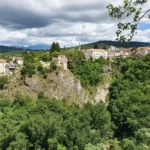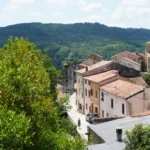

Tucked into the western foothills of Učka, the picturesque village of Boljun once held great strategic importance. Perched on a 254-metre hill, with steep slopes guarding it on three sides, this old fortified town now rests in quiet beauty, carrying its history gently through time.
For those who want to fully experience Istria, it will certainly not be enough to visit only major tourist destinations on the coast. What will reveal complete authenticity are tiny, quaint villages that are overflowing with nature and beauty. Considering such destinations of Istria, which we often write about, it can be said that Boljun is undoubtedly one of them. Located at the foot of a hill that seems like an “abyss” looking at it from above, it also gives it a special charm.
Ever since the Illyrian tribes built a fortress on the hill below Učka, they had no idea of its future strategic importance. It was soon taken over by the Romans who called it Ad Fines or Alvum. They used it to monitor the road between Liburnia, western and southern Istria. Today, Boljunis a small town with panoramic views of the surrounding areas. The view from the village is overwhelming with a view of the Ćepić Polje Valley and the Belaj Castle. The area of Boljun in addition to being significant for historical monuments is home to magnificent forests and meadows or endemic and animal species.
Hidden beneath the slopes of Učka, Boljun feels like a secret kept by the mountains. Perched on a 254-metre hill above the Čepić Valley, this forgotten Istrian stronghold has watched centuries drift by — from Illyrian fortresses and Roman outposts to Venetian skirmishes and the hush that followed. Today, its peace feels almost sacred. Boljun is not a town that shows itself quickly. It unfolds slowly, as you pause by a doorway, follow the echo of your footsteps, or stop to admire the bell tower — one of the oldest in Istria. The surrounding landscape invites long walks through vineyards and oak forests, where trails lead toward the Studenac spring or the ruins of St. Peter’s Church. Everything here moves at the pace of the wind.
Things to doin Boljun
When I first arrived in Boljun, I was amazed by the trees, the greenery and the vibrations in the air of the paved streets. This medieval fortified town on a hill may not be as popular as similar hilltop towns such as Motovun, Grožnjan or Oprtalj. Yet that doesn’t mean it’s not just as magnificent. Boljun will offer a holiday with everything you need: comfortable accommodation, untouched nature, peace and, of course, specific local specialities in your tavern. All ideal for a social distance away from the crowds of big cities so they can recharge their batteries. You can simply sit, drink and enjoy the views.
But still, Boljun offers much more than a view. As we mentioned in the introduction, this is an ancient city. In Latin documents of the Middle Ages (1303) the name Baniol or Bagnoli is found, which probably originates from the late Roman Bagnolium or Balneal. Venetians, Austrians and Uskoks fought for its streets in the Middle Ages (1612). From the 15th to the end of the 17th century, “neither town nor village” reached its peak, and the Glagolitic alphabet was used. Since then, however, Boljun has lost importance, but the city has not collapsed. On the contrary, today it pleasantly surprises every excursionist with its legacy.
Walking through Boljun is like stepping into a still photograph: cobbled alleys, weathered facades, and the faint scent of pine carried on the wind. The village, once called Ad Fines by the Romans, grew around a medieval castle that still crowns the hill. From its stone terraces, views stretch over the valley toward Belaj Castle and the green folds of Učka — landscapes that seem painted in calm.
Church of St. Cosmas and Damian
The church, which dates from the 12th century, at the entrance to the place with inscriptions testifies to the times of construction. There is a Glagolitic inscription next to the sacristy wall from 1543, while Latin inscriptions from 1698. And those on the triumphal arch from 1705. It was built next to the former main gate, which was destroyed after the First World War to allow vehicles to enter the place.
Boljun Castle
The centre is dominated by a castle built in the 11th century. The castle surrounded by winding cobbled streets was created to defend the city. Similar to others in Istria and during the war (mostly for defence against Venetian attacks in 1332, 1612), the castle was a haven for the inhabitants of Boljun and those who came from the surrounding area. Until recently, there was a pond in the centre of the yard, but unfortunately, it is flooded and today it is used for events. A small door can be seen near the north corner.
City loggia
Although it was never conquered by Venice, which still managed it indirectly, in Boljun you can see a part of the city loggia, which is reminiscent in shape of those in Venice. However, this form is only in the arches, not at all like in the cities that were under Venetian rule. The loggia that served as the meeting point for the mayor and judges of Boljun was erected behind the font. The granary housed grain and other agricultural products that the inhabitants of Boljun paid as a tax to the rulers.
Parish Church of St. George
The parish church of St. George from the 16th century is characterized by Glagolitic inscriptions from 1590 and 1641 and a late Gothic polygonal sanctuary. An inscription from 1641 on the back outer wall was written by a Glagolitic and Boljun parish priest. The church, rebuilt in the 17th century, has unusual stone “pine cones” scattered along the wall surrounding the church, and the relief-paved sidewalks are most likely taken from an older building.
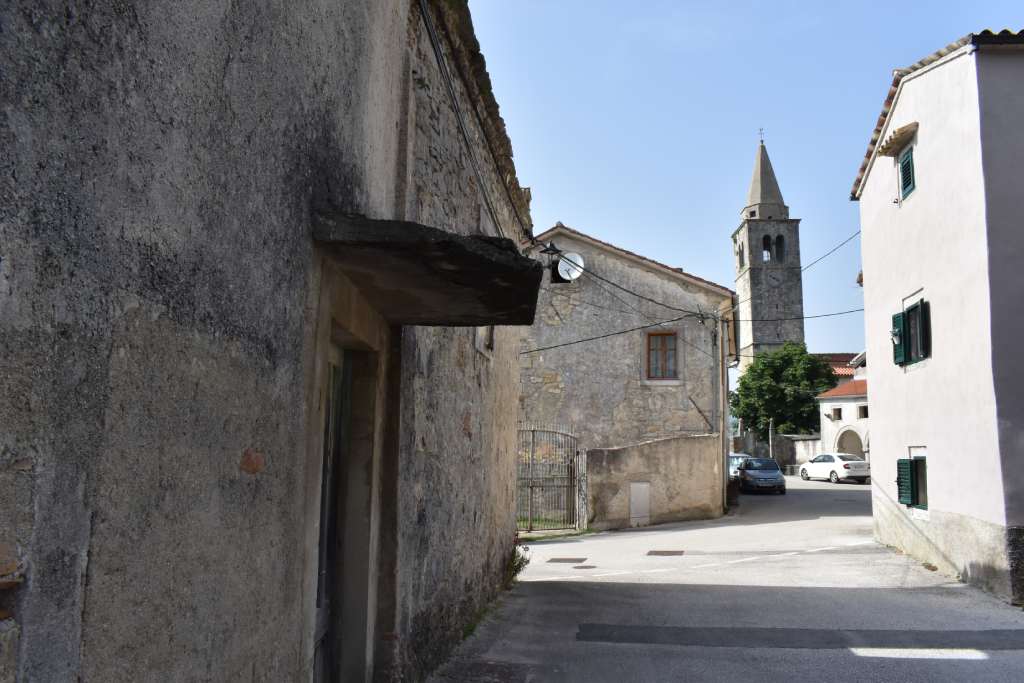
Next to the church is a bell tower. A Latin inscription on the bell tower from 1645 indicates that the Boljun bell tower is one of the oldest in Istria. Don’t miss to photograph it because this is one of the symbols of Boljun. Calvary from 1914, is located next to the Parish Church of St. George on the left.
The views and architecture of the narrow streets
Yes, look again… and not by chance because Boljun is a small town with wonderful views. To get the best-unobstructed view, all you need to do is climb up to this town. Once you get there, you will be relieved of any stress. It seems that this place is really with a beautiful view of the Boljunčica valley, Čepić Polje, Plomin bay down… but at the same time, we will enjoy the view of Učka, the mountain with the highest peak in Istria – Vojak. He seems like a giant as we watch him from there!
Medieval streets
A walk through the picturesque streets of Boljun is one of the things that will allow us to get to know Istria. The small town made entirely of stone reminds me strongly of one of the sets from the modern ” Game of Thrones ” or ” Harry Potter “. Located at the bottom of the slopes of the Učka mountain, it is a town of typical Istrian architecture, which will often take us back to the past. And most importantly, once you get in full contact with the place you will discover so many details.
Church of St. Fabian and Sebastian
This church dating back to the 12th century is located on a rise from the valley, and if you enjoy the view of medieval architecture, you should not miss a stop next to it.
Boljun events
As almost every other Istrian town has, so Boljun has its own, of which the most famous in Boljun is ” MarinjinavaBoljunu “. The traditional feast held every July is a good opportunity to meet traditional Istrian songs.
Daily tours in Boljun surround
Bounded by similar hilltops were also the castles dominated by the Austrian and central European impact than Venice. This part of Istria seems to have a superb choice while you are in Boljun.
Belaj
The castle located in the foothill of Boljun is a valuable Baroque complex consisting of a residential area of the castle, a wine cellar and stables that have a long historical time. A court given as a gift from Henrik ruler by Ulrich Weimer – Orlamünde was donated to an Aquileian patriarch in 1102 when it was first mentioned. Most of the time, the castle was subordinated to the Habsburg Monarchy rulers who ruled it until WWI. The most recognizable names of the owners you’ll learn: Daniele Barbo, the first owner of the manor house, and John Weikhard von Auersperg (1615 – 1677), a diplomat, and minister and advisor to Emperors Ferdinand III and Leopold I.
Today you could see the ground floor of the castle has a chapel of St. Henrik, which is the only chapel in Istria dedicated to him. The court which could also be seen from Paz or Boljun is bounded by the green wine yards area and today is the residence point.
Ancient Hum
Located just 14 kilometres away from Boljun, the tiny Him is a place you should visit while you are in this part of Istria. Many repetitively talk about Hum’s identification as the holder of the Guinness Book of Records as the smallest place in the world. But there is no evidence to prove it. I can’t imagine any other city so little in the world.
And since there isn’t much about tourist attractions in Hum town, simply because of its size, it’s surrounded by some of the most beautiful scenery you’ll see. And there is a tavern serving traditional Istrian food in the village too. The reasons you should visit are to take a look at the frescos in the Romanic chapel of St. Jerolim and make a tasting of the local brandy known as “Humska Biska“. The brandy made from the town’s mistletoe has its feast in October when the Town of Hum holds a Grappa Festival.
Paz
Located straight opposite Boljun and situated between Borut on the other side of Paz, having the few rural houses is scenic and quaint. Similar to Boljun in Paz you can enjoy the beautiful views of the Učka slopes while enjoying the mountain and valley feel at the same time feel.
The thing most inspired me to get back into Paz was the view from the cemetery and the calmness of the area that is dominated by the however few of the sites such as remnants of the “Castle Paz”, The parish church of the Blessed Virgin Mary in Paz dating back to 1579.
Boljun outdoor
Apart from all that, the beautiful surroundings of Boljun seem to be rich and perfect for enjoying walks and outdoor activities. Next to the town, only five minutes away is the Studenac spring. A very unique place provides an opportunity for refreshment. There could be seen the ruins of the church of St. Peter, where ornaments from the 9thcentury were found. Those arekept in the Historical and Maritime Museum in Rijeka.
Putokoza local tips
The magnificent surroundings of Boljun are bounded by the area dominated by the grapevine cultivation and winemaking which have been among the most recognizable activities in this part of Istria. The things you shouldn’t miss:
Step back in time with a historical tour of the town. Boljun stands out as a premier location to enjoy your visit outside from the crowds and enjoy the mountain wind air. Simultaneously, one will enjoy overlooking the ancient city: nothing inner than strolling the cobblestone streets and enjoying the incredible view.
Taste some local food or drinks in “Boljunska Konoba” or the few of the other tavernas located down in the valley.
Getting to Boljun
📍 Where it lies: In the eastern part of central Istria, below Mount Učka, overlooking the Čepić Valley and the village of Belaj.
🚶 Wander: Medieval lanes within the old fortifications, the 11th-century castle, and the peaceful main square beside the parish church.
⛪ Sacred corners: Church of St. Cosmas and Damian (12th c.), Parish Church of St. George with Glagolitic inscriptions, and the Chapel of St. Fabian and Sebastian above the valley.
💧 Hidden gems: Studenac spring and the remains of St. Peter’s Church; panoramic views of Učka and Plomin Bay from the upper walls.
🍷 Local life: Visit in July for Marinjina va Boljunu, a traditional feast filled with Istrian music, wine, and laughter beneath the old bell tower.
🐐 Putokoza tip: Come in early morning light — when mist rises from the valley and Boljun feels suspended between earth and sky. Bring water, time, and no plans. 🅿️ Practical: Easy access via the Učka Tunnel or local roads from Pazin and Labin. Parking available below the old town. Nearest hubs: Pazin (20 km), Rijeka Airport (60 km), Pula (70 km).