
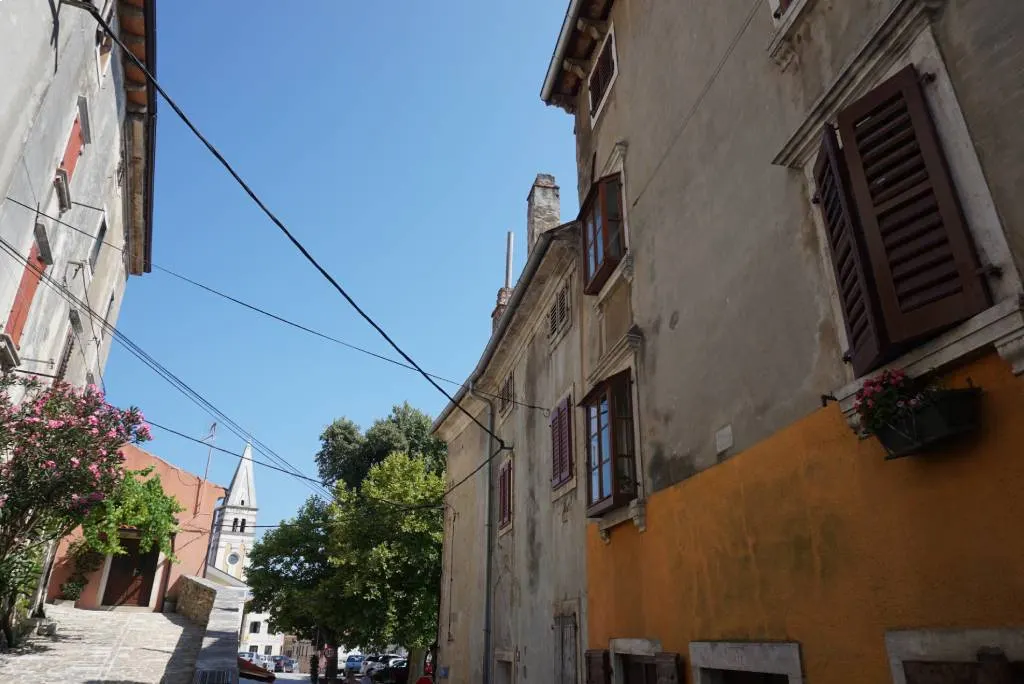
Perched on a 222-metre hill in northern Istria, the small town of Buje is marked by its two proud bell towers. From here, views open over rolling green landscapes, while the town itself shines in colour and quiet charm.
The first sight is deceptive: the calm streets, the stone houses, the distant hum of cicadas. Yet, beneath that stillness, history breathes with the patience of someone who has seen it all — from the prehistoric tribes and Roman settlers to Venetian merchants and medieval guards.
The story of Buje begins long before it was written down in 1102 as Castrum Bulleae. Even before that, prehistoric tribes — the Katali — made their homes here, on this very ridge. The Romans called it Bulle, then the Venetians claimed it, and through the shifting centuries, the town has remained — proud but never loud.
Travelling northern Istria: B means Buje
The ancient Istrian town illuminated by picturesque Mediterranean artistic architecture provides a unique experience of its millennial history. Buje is a city with lookouts of magnificent views of the landscapes of northern Istria. The streets of Buje preserve the tracks of the past in their corners. Those corners would reveal ancient times. Back then, Buje was known as the „the “Guardian of Istria“. Standing here, surrounded by views that stretch to the Alps and the Adriatic, it’s easy to understand why.
Each stone underfoot carries traces of another century, another ruler, another dream. The past isn’t confined to museums or plaques — it lives in the rhythm of footsteps echoing through narrow alleys, in the soft clang of the church bells, in the scent of olive oil pressed from trees older than memory.
Things to capture in Buje
Buje is certainly one of the towns that will allow us to experience Istria as it is, that is, authentic and original. I realized this, not only after walking through Buje but also after meeting local people who tell their stories about the city and their past. These are not only stories about sights, but also real-life, combining the influences of the town with different areas of the area from Istria to the Alps.
Walking through Buje feels like leafing through a family album of Istria itself. There’s the parish church of St. Servolo, where the unfinished façade reveals layers of faith and time. The climb to the bell tower — the highest in all of Istria — rewards you with a panorama that seems to gather the whole region in its embrace: the vineyards of Momjan, the shimmering horizon of the sea, and the gentle roll of the hills.
Look at the Church of Our Lady of Mercy
The 1498 building has a 22-meter-high Venetian bell tower from the 18th century. It was built in 1583 by the expansion of the city in the 15th century outside the original core and was extended in 1832 by a bell tower along the southern facade. In addition to offering a beautiful view from the front, the church also contains a statue of the “Mother of God”, the work of Venetian master Paolo Camps. Legend has it that upon his return from Venice, where he bought the statue, Paolo Razizzi found the city gates closed and spent the night outside. During the morning time he could not move the statue, not even with the help of a horse. This was taken as a sign that a church would be built on the site.
Stroll the Freedom Square
The square surrounded by houses has all the elements of an Istrian medieval town. The tap with drinking water is on the square, uncovering one of the few authentic legacies of Istria. Apart from the fact that the square offers a beautiful view of the Umag area and green landscapes, traces of the Venetian rule that ruled Buje for four centuries can already be felt here. However, this is just the beginning of the experience that Buje will provide you.
Enjoy the Saint Martin cemetery viewpoint
The cemetery located in the yard of the small picturesque St. Martin chapel is not nearly as a typical cemetery as it sounds at first. On the contrary, a very relaxing and sacred place is more like a park. And it is dominated by the chapel of St. Martin, dedicated to “St. Martin”. The chapel bordered by cypress trees from the 16th century, has one porch, a small apse, and an altar with a plaster statue of Pieta. On a beautiful day, you can simply relax enjoying the beautiful view of the green landscapes and the blue sea. Looking at the combination of blue and yellow in the distance from the shaded ground sounds suitable for a break.
Next to the cemetery, there is the “Gate of St. Martin” also known as the “Western Gate”. Those are protected by an extremely large tower of St. Martin right next to the gate. Of the many towers of the defence system, it is still possible to mention in part the quadrangular shape of the tower. A passage with a gentle arch bearing the same name as the church is located opposite the cemetery and leads into a cobbled street with streets, which reveal houses with artistic facades.
Admire Parish Church of St. Servolo in Buje
The parish church located on the square of the same name is a single-nave Baroque-Neoclassical building from 1784. It is characterized by a barrel vault and an elliptical dome. It was built on the site of a Romanesque-Gothic church from the 13th century. Although the unfinished façade looks confusing, many elements of the old ruined church are still visible in the church: a sacrificial vessel carved in white limestone. Parts of the pillars and ancient inscriptions built into the church indicate that there was also a Roman temple at this place. The facade of the church is made of stone, which can be seen by the entrance surrounded by stone pillars with a decorated rosette made in the shape of a shell. It is the work of the Buje master-builder F. Urizi.
Step on the highest bell tower in Istria
As chords of a sonata at the very top of the town next to the parish church on the same square, there is a picturesque bell tower. With its height of 50 meters, it is considered the highest bell tower on the Istrian peninsula. And not only that. The bell tower probably leaves us with the best memory of Buje.
We met the bell ringer in the tower, teacher Bruno, who explained in great detail the construction of the bell tower and the history of Buje. Once you climb to the top, you’ll get the whole Buje in the palm of your hand. So large it seems that the climb is worth every step taken. Belfry of St. Servolo is a very unforgettable experience and you have to climb it!
The ancient architecture in Buje
Buje’s unique medieval appearance has retained the remains of the former defence system: walls, two city gates and a pentagonal tower. All these elements are proof of a turbulent past. Climbing the street with houses of colourful facades from the new part, we reach the older part of the city with a layout of palaces in the Gothic style.
Although Buje is located on the mainland, the shadow of the houses will remind us that we are in a Mediterranean environment. This is partly true because the coast is not that far away, and on the other hand, many streets still have a Venetian influence. After the place enjoyed the status of a free commune (1257 – 1412), four centuries of Venetian rule followed. It is the Venetian period actually that leaves the most traces: Gothic-Venetian palaces, the square, the town loggia and the town hall.
The remains of the Slavic Acropolis and various rulers
The remains of a Slavic acropolis from the 9th century testify to the fact that the city was inhabited during the Early Middle Ages. Then a group of Slavs fleeing from the enemy arrived in the area of today’s Buje. It is assumed that at that time the forts were built on flat tops of hills, while in the next few centuries Buje changed rulers: the Franks (until the 11th century), and Aquileia (until the 13th century).
City loggia and necropolis
Located on the St. Margaret hill, east of Flavius Road, which leads to Freedom Square, the town hall and the old fair (Sucolo) were traditional gathering places. Next to them, there stands a medieval necropolis from the 7th and 8th centuries.
Chapel of St. John the Evangelist
The chapel with the red facade from 1788 is located in the very centre of the city. It is being restored by Count Konstantin Vlasto. Stone pillars with an artistic facade form the edge of the door towards the “Crocera street”, meaning “the street of passage”, translated from the local Italian language.
Buje Ethnographic Museum
Approaching the former city gate of the former defensive wall from the 17th century, we come to a museum on four floors. It represents the reconstruction of the interior of an old Istrian house. It contains the elements as kitchen, bedroom with handloom, olive processing area and craft room. A very interesting feature is the handicraft of old coffins from the Buje area.
Daily tours in Buje surround
Located very north of Istria, the Buje area is scenic. The green Istrian hills bound the place. And wherever you decide to go, you won’t be wrong. Here we prepared just a few of the ideas.
Momjan
Located close to Buje with having the citadel and Church of Saint Martin which are the most exciting features, Momjan is picturesque and historical. The place surrounding wonderful nature. It has become famed for “Momjan Muscatel”, a wine of specific odour and aroma you should try while visiting it.
The place is divided into two parts of Gornji Momjan and Donji Momjan. Donji Momjan is a citadel house dating back to the 13th century located on a rocky hill. At the same time, Gornji Momjan is dominated by the 22-metre high bell tower and the Church of St. Martin, which dates back to the 15th century with has a Baroque altar in the interior.
Triban
With lush greens and the autochthonous architecture characterized by stone houses having external balconies and staircases, typical for this part of Istria, Triban is very scenic and tiny. Located close to Buje, the place is dominated by a 22-metres high bell tower added in 1872. Next to it is the parish Church of St. George dating back to 1656 on an older church’s remnants.
Savudrija
The boats hung above the sea making the most recognizable postcard of Savudrija. That it is the westernmost town on the Istrian coast.
Besides the lush green and fantastic view extending to Koper, one of the top attractions is the 36-metre lighthouse. It is considered the oldest in the Adriatic. The lighthouse was the first one in the world that used the gas produced by the distillation of coal. The gas was delivered from the Labin mine. However, the thing that made him famed is a quite heart-warming love story associated with its past.
Getting to Buje
📍 GPS. Latitude: 45.410530, Longitude: 13.655930
📍 Where it lies: Northern Istria, between the hills of Momjan and the coastal plains near Umag. Elevated at 222 metres, Buje overlooks vineyards, olive groves, and the distant shimmer of the Adriatic.
🚶 Wander: Stroll from Freedom Square to the parish church of St. Servolo, then climb the 50-metre bell tower — the tallest in Istria. Explore cobbled streets lined with Gothic-Venetian façades, city gates, and remnants of medieval walls. Don’t miss the cemetery of St. Martin for one of the most peaceful viewpoints in northern Istria.
⛪ Sacred corners: The Church of Our Lady of Mercy (1498) with its Venetian bell tower, the chapel of St. Martin with its cypress-lined yard, and the red chapel of St. John the Evangelist (1788) — each telling its own quiet story of devotion and endurance.
💧 Hidden gems: The Ethnographic Museum housed in an old Istrian home reveals daily life from centuries past. Walk toward the old “Gate of St. Martin” for a view framed by stone arches, or seek shade beneath the loggia on St. Margaret hill.
🐐 Putokoza tip: Arrive just before sunset. Climb the bell tower and watch how the light slides over vineyards and rooftops. Then find a local tavern and order Muškat Momjanski — a golden wine that carries the taste of these hills.
🅿️ Practical: Easy to reach by car from Umag (10 km) or from Slovenia. Parking near the old town can be limited; best options are below the hill. Nearest airports: Pula (PUY), Trieste (TRS), and Ljubljana (LJU). Local buses connect Buje with nearby Istrian towns.