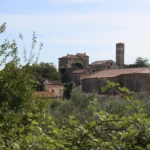
Located in the Istrian peninsula’s very centre, on a 262 meters high cliff above the pit that is the subject of numerous legends, Pazin is vibrant and relaxed.
The old Pazin town located right above the Pazin Pit (Pazinska Jama) standing like a knight seems to be unconquerable at a glance. It will however welcome a visitor with a friendly atmosphere. Once stepping onto the peak of the cliff, you’ll notice this town is not only a lush heritage but was also born for the adventure seekers. Let me tell you, Pazin will get you with all of its characteristics: the walls, a citadel laying on a cliff above which one enjoys Zip-line. Eventually, the most important thing is the turbulent and vibrant atmosphere because one would get stuck into Pazin.
Travelling central Istia: P means Pazin Pit
Although Pazin was first officially mentioned in 983 as the fortress “Castrum Pisinum“, traces of life over the Pazinčica river flow, date back to around 1500 BC. People lived on the cliff above the Pazin Cave still during of Bronze Age, leaving behind only pottery fragments. Almost 2,500 years passed from the time when the first habitants made the earliest remnants in the area. The such were beginnings of city history.
Located in the heart of the Istrian peninsula, Pazin seems to look more appropriate as the place is located more inside of central Europe than the heartland of Istria is. In fact, unlike the coastal part of Istria Pazin area was under central European influence during its past. Almost every point of Istria on the west, east, north nor the south is equally distant from Pazin. Because of it, the place is very well connected.
3 things to do in Pazin
Pazin is considered to be the heart of the Istrian peninsula. Lying on the hill located at the edge above the cave that bears the city’s name, at an altitude of 262 meters, Pazin offers a unique experience. Visitors will enjoy a combination of adventurous and historical backgrounds.
1. Enter the Pazin Citadel
The symbol of Pazin is the feudal castle, built on a cliff above the cave, through which the river Pazinčica River flows. An imposing fortress on the edge of a pit, it has existed for more than a thousand years. Apart from being one of the best-preserved medieval fortresses in Istria, the castle on a hill above a deep canyon is a scene from medieval films. It records a significantly higher number of changes of ownership compared to others in Istria.
In the charter by which Emperor Otto handed over the Pazin Castle to the Poreč diocese in 983, Pazin is mentioned in the Latin form ” Pisinum “. German rulers called it ” Mitterburg “. It is believed that for centuries, the only access to the castle was a steep road that descended through today’s Buraj. Habsburg Family owned the castle from 1374, while during the 15th century, the castle was Pazin County centre.
Local tip: visit an ethnographic museum. The ethnographic collection located inside the fort contains more than 4,000 costumes, and agricultural tools, including those from the 19th and early 20th centuries. Since Pazin was also a town of blacksmiths, there is the exibition on the groud floor. In addition to the permanent exhibition that includes original objects, replicas and photographs of the prehistory of the early Middle Ages, there are also objects such as weapons, and exhibitions of Gothic, Renaissance and Baroque bells of Istrian bell towers. The museum also has a valuable collection that shows the life and works of the Istrian bishop and writer Juraj Dobrila.
2. Get adventure at Zip Line
Next to the castle, we notice the famous picture of the view towards the “Pazin Cave”. For a complete experience, adventure enthusiasts or adrenaline seekers shouldn’t miss tasting this adventurous trip. The adventure starts at the edge of a cliff below the hotel “Lovac“. With the two steel cables above 100 m ground level, you’ll enjoy flying above the cave. The first steel cable is 220 m long, reaching a speed of 40 km/ will land you in the yard of the “Writer’s house”.
It’s also the starting point to begin the second line (280 m). The next zip could reach the speed of 50 km/h offering you however enough time to enjoy the unique view of a glorious abyss and a medieval castle on its cliffs. It will land you on the viewpoint above the “Grandma’s house” cave. After finishing the zip-line, Pazin’s story has still not ended. Right there you’re standing precisely on the spot from where Leon Bennet made the famous photo of illustrator due to preparing gravure for Jules Verne’s “Mathias Sandorf novel.
The pit at a depth of 125 meters is perhaps best seen on the concrete bridge above the cleft. The unique hydro-geological-speleological phenomenon has been declared a protected natural monument since 1964. Another famous writer, Dante Alighieri, writing parts of his ” Divine Comedy ” (” Inferno “), describing it as ” The Gates of Hell “, mentions the mysterious entrance to this pit. The semicircular cave inside was named “Dante’s Lobby“. Gallery with Martel Lake, named after the French speleologist Martel. He made together with Putick, a Czech expert the first cave research at the end of the 19th century.
3. Stroll the old town to see the monuments
Pazin in the heart of Istria, located in a valley, but at the same time on a hill, will reveal many sights. And not only that. The streets of Pazin are a place of events throughout the year. All of them will reveal some of the stories of turbulent history.
St. Nicholas Church. The church named after the patron saint is located in the centre, not far from the castle. The church built as a miniature in 1266 was expanded in the Gothic style, during the 15th century. The interior reveals the Gothic style, decorated with frescoes from 1460. These are among the most beautiful late Gothic in Istria. Inside is an organ from 1780. Next to the building stands one of the recognizable symbols of Pazin, a bell tower with a height of 45 meters. It dates back to 1705.
Pazin College. The imposing building with a yellow facade, known as the “Pazin College” today serves as the “Classical Gymnasium“. It was built in 1913-1914 to accommodate students in the then gymnasium. After the end of WWII, the building in it opened as the Episcopal Seminary with a classical grammar school.
Franciscan monastery. The 15th-century monastery was established by Franciscans from Dalmatia, including the Church of the Visitation of the Blessed Virgin Mary with a late Gothic presbytery. It was made according to by the St. Nicholas church. The monastery had an infirmary pharmacy and a valuable library. In honour of the Pazin Franciscans, who are celebrating Rome or “Porziuncola ” as their biggest holiday, today on the first Saturday in August, a manifestation is held in early August. It is the most famous event in Pazin.
Pazin outdoor
Located in the heart of Istria, whose land is ideal of various combinations of karst and landscape, Pazin and its surroundings will provide an excellent experience for outdoor seekers. The Pazin area is lively and picturesque. And not only that.
Pazin’s list of the outdoor activities
Apart from the green Istrian hills, Pazin is not far away from the other small places that are not so far away. So, wherever you go, you will get some new inspiration.
Hiking. The possibilities for walks in the vicinity of Pazin are countless. Therefore, many of them are marked hiking trails. The gathered necessary information about your possibilities in one place you can find in the Tourist Board office.
Cycling. Pazin has become more popular to be a cycling destination, and it’s not just a current trend. The long-term existence of quality cycling federations for cycling has resulted in the development of various trails. Those are suitable for both beginners and advanced riders. Take a look at the Istria bike that was presented to find descriptions and maps.
Speleology. Due to suitable weather conditions, you can enjoy the pit visit organized by the “Speleological Society of Istria” and “Natura Histirica” throughout the year. They provide a tour of the underground of the “Pazin Cave” with the expert accompaniment of local speleologists. To experience this speleological adventure, you need to announce yourself to society in advance.
Climbing. Sinceevery year, the local club “Hiperaktiv” conducts training for the youngest ones, it resulted in forming the numerous the number of directions determined around “Pazinčica cleft”. Pazin has a growing number of climbers of all ages showing how successful this well-coordinated team intends to spread a festive and healthy sports spirit for many years.
Pazin Hiking tip: Pazin – Grdoselo trail
One of those “undiscovered routes of Istria” is the trail towards the tiny village of Grdoselo. The path that runs next to the castle leads over the bridge over the Pazin Cave to the hill ” GortanovBrijeg “. In 1177, the monastery “St. Mihovil” was abandoned. During the 14th century is assigned to local nobles.
The information I found is that Dante Alighieri is also on the same hill, describing the view from “ Gortan Hill ”, similar to the description of entering the Pazin pit. I have to admit we didn’t see the “Entrance to hell”, but we were amazed by the natural beauty. Furthermore, a trail leading through a magnificent landscape will lead us to Berm. Apart from being considered the most famous for the church of “St. Mary on the Slate”, Beram is one of the oldest continuously inhabited settlements in Istria. Ultimately, the picturesque Grdoselo will provide beautiful views of Lake Butoniga.
Daily tours in Pazin surround
Located in the very centre of Istria, the Pazin area is vibrant and picturesque. Besides the green Istrian hills, it’s bounded by similar small places that are not so far away, so wherever you decide to go, you’ll get some new inspiration. Here we prepared just a few of the ideas.
Beram
As already mentioned above, Beram is known for its Gothic church of “St. Mary Na Škriljinah”, located in the graveyard. The church has exceptional frescos from 1474, the work of Vincent of Kastav famed as “The Dance of the Dead”. The church location is in a shadowed alley next to Beram.
Surrounded by green hills and meadows Beram are a lush nature and outdoor paradise.
Draguć
Located in the very central part of Istria, Draguć offers a beautiful and unique view of Lake Butoniga and its surroundings. This tiny town once was a Venetian fortification and grand Baroque and Classicist houses lining its main street.
With most of its town square features such as a well, granary and 15th-century parish church on its town square and a picturesque balcony, Draguć is historical vibrant and compact. Every visitor searching for inspiration shouldn’t miss visiting it.
ZarečkiKrov (Zarechki Roof)
One should not miss visiting “Pazinčica River”, a fascinating natural attraction in the area. Above the river’s flow, a spacious cave created a ten-meter waterfall with a deep lake. Below the waterfall is suitable for swimming in the summer months and is only a few mutes far away from Pazin. More experienced climbers use the surrounding rocks for recreation.
Every year, a swimming school is organized on the “ZarečkiKrov” for the youngest. The older ones can become water polo players for one day or lower the summer temperature by swimming in the city.
Boljun
Standing at the hilltop in the very centre of Istria, the remarkable Boljun castle dates back to the period between 11th and 17th centuries. In times of war, it served as a refuge for Boljun and the surrounding area. A pond in its courtyard centre was filled out and used for different cultural events and performances until recently.

The round stone table inside the castle offers a nice view of the Boljun valley. Not coincidentally, the defenders of Boljun quickly saw Venetian mercenaries’ incoming army in 1612 and thus successfully defended the city. At the time, only the castles of Boljun and Pazin could resist attacks. Next to the northern corner of the court, there is a small gate. Besides the historical significance, Boljun will offer a unique central Istria experience with his magnificent view extending of the Učka above, Butoniga Lake, Paz or Belaj.
Žminj
Another central Istrian town located on 379 meters high hill suroods a hilly landscape with interchanging red soil and green plants. It is a medieval town with magnificent green areas encircling it. Though on a peek it used not be well known as the other Istrian hilltops, Žminj that first mentioned in 1177 is ancient and authentic.
Whenever you want to reach Žminj, you can do it quickly since it is on the crossings of Istria. It has been a critical transport junction due to history for a long time. Its 17th-century Baroque church well knows Žminj of St. Michael (Sv. Mihovila) and the green meadows that surround the place. If you’re in Istria at the end of August, then you shouldn’t miss visiting its traditional feast of Bartulja.
Getting to Pazin
Located in the very centre of Istria Pazin, should be very easy to reach.
📍 GPS. Latitude: 45.239269, Longitude: 13.936420
✈️ Air. Pula Airport is about a 45-minute drive from Pazin. Though not large, Pula Airport serves over 70 destinations with different airlines, including low-cost carriers such as EasyJet and Ryanair. From the airport, you can take a bus to the town bus station, from where there are connections to Pazin. However, the best option is usually a private transfer or taxi. Rijeka Airport is approximately 80 km away from Pazin. Trieste Airport is around 140 km, Venice Airport about 250 km, while Zagreb Airport (225 km) and Ljubljana Airport are also possible alternatives.
🚌 Bus. The Pazin bus station connects with lines from all major Croatian towns. Several international routes also run to Pazin (for example from Munich, Trieste, Karlsruhe, Geneva). The bus station is located less than 500 metres from the city centre—just a 6-minute walk. There are multiple daily connections with the capital, Zagreb.
🚆 Train. If you prefer to travel by train, Pazin can be reached from Zagreb or Ljubljana.
🅿️ Parking. There are several designated parking zones in Pazin. Ticket prices vary depending on the zone and time of year.