
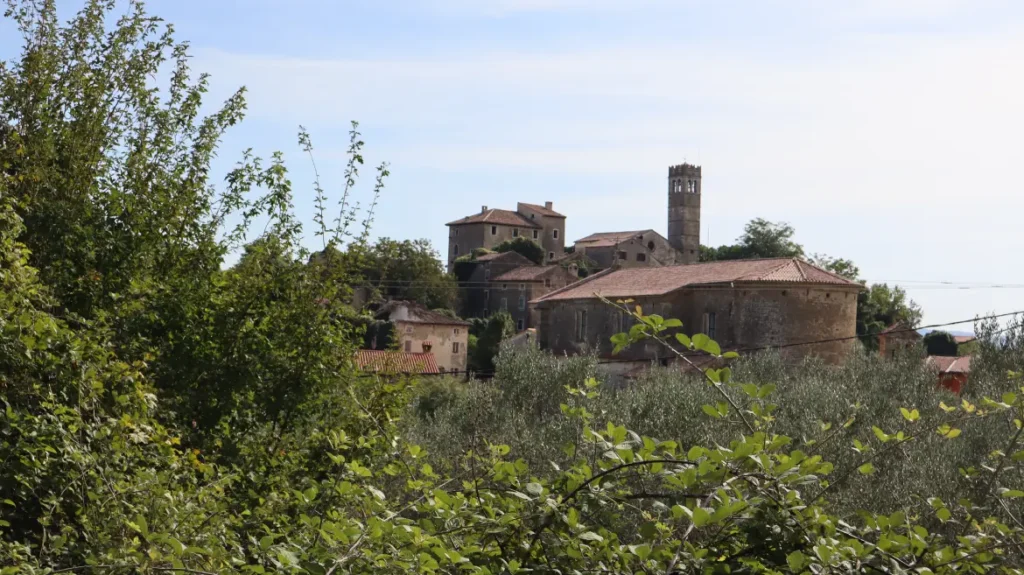
Završje (also known as Piemonte d’Istria) sits atop a hill at 373 m, on the right bank of the Mirna River in Istria, Croatia. This tranquil, picturesque place was chosen as the home of the famous outlaw Robin Hood—and not without reason.
Perched 373 metres above sea level, Završje seems suspended between earth and sky. It is wrapped in ivy and memory. At first glance, it feels like a dream caught in stone. Cobbled lanes climb toward a leaning bell tower, and the silence reveals your own footsteps. From afar, the town seems asleep. Once you pass through its old gates, the whisper of centuries begins to stir. In this rare stillness, visitors find a quiet that lets them hear their own heartbeat. Each moment here feels peaceful and deeply personal.
Although Završje is close to Motovun, it feels far removed. Quiet and patient among its serene ruins, the town crowns the hill alone. Time slows when you enter. Završje sits on a cliff and is one of Istria’s most secluded places. Few venture here. Those who do arrive slowly and savour the journey. Motovun welcomes thousands of visitors during peak season, creating a bustling café scene and a lively atmosphere. Završje hosts far fewer guests. Here, you might pause beneath a crumbling stone arch and hear only birdsong echoing in the valley. This tranquillity makes it feel remote, offering sounds of nature where Motovun’s chatter might fill the air.

I knew Istrian hill towns were picturesque, but Završje revealed its uniqueness only upon arrival. The magic here is not just in the views but in the stories waiting to be discovered. Završje’s story to tell is that of a living stage: while wandering its quiet streets, you are quite literally stepping onto a film set that has played host to legends. When scenes from the 2018 Robin Hood film, starring Taron Egerton, were filmed here, Završje became the backdrop for cinematic heroism, seamlessly weaving pop culture into its centuries-old fabric. Now, the town wears this story as part of its identity. The ancient archways and cobbled lanes invite each visitor to co-create the myth, offering everyone the chance to step into the role of Robin Hood for a moment—whether retracing the outlaw’s steps for your own Hollywood shot or simply soaking in the creative energy. Završje does not remain a relic of the past; it’s a place where new legends await those who visit.
Still, Završje is not a spectacle. It is, above all, a town. Built atop a prehistoric hillfort and strategically important to the Romans, it has roots that stretch back thousands of years. Medieval and later Venetian rulers recognised its value, reinforcing its defences and shaping the settlement that remains today.
Završje’s churches reflect its spirit. As you climb, time lingers in the stone. To make the most of your visit, start at the parish church near the entrance. Then follow the cobbled lanes upward toward the bell tower and the heart of town. It’s easy to imagine life once in these lanes. Below is a short list of things to see as you explore Završje at your own pace.
Završje in history
Learning about small, picturesque places is one of the best ways to sense the true spirit of central Istria — and to glimpse how life once unfolded here. Završje, known through the centuries by two different names, carries a layered story worth taking time to uncover.
Završje’s name likely refers to its sheltered position among the hills. The Italian name, Piemonte d’Istria, first appeared in the early 12th century. Piemonte means “at the foot of the mountain.” The d’Istria part distinguishes it from Piemonte in northern Italy. The town appears in records as Pyamont, Poymont, and Pemund before settling on today’s names.
From lords to empires
The first written record of Završje dates to 1102. Marquis Ulrich II of Weimar donated Piemonte d’Istria to the Patriarchs of Aquileia. Over the centuries, the town changed rulers multiple times. It belonged to the Counts of Pazin, came under Austrian rule after 1374, and was repeatedly attacked during the Venetian wars.
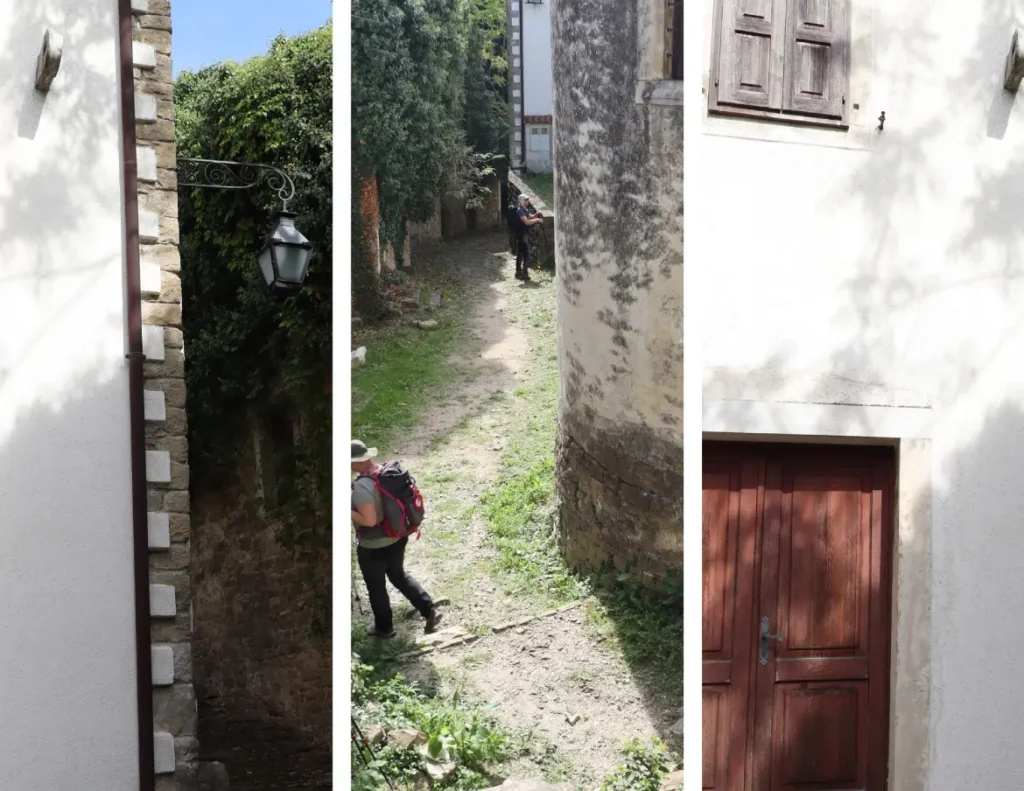
In 1511, Venice officially took control, and by 1530, the town passed into the hands of the noble Venetian family Giustinian Contarini, who ruled Završje for almost three centuries. Many of the town’s most recognisable landmarks date from this long and defining period.
A town on the move
After Napoleon’s brief rule, Završje returned to Austrian administration, then later to the Kingdom of Italy. The early 20th century was a prosperous era, thanks to the Parenzana railway. This railway connected Istrian hill towns with Trieste’s port. As a local elder recalled, “Every morning, you could hear the train’s whistle echo through the valley. The sound meant work, visitors, and the promise of something new. Our little town felt wide awake in those days.”
The railway brought trade, agriculture, and crafts. Završje gained a post office, school, shops, and an oil mill. The streets were filled with life and movement.
Decline and renewal
During and after World War II, Završje became part of Croatia. Like many Istrian hill towns, it faced significant emigration due to economic challenges. The population dropped from nearly a thousand to about fifty. The once lively streets grew quiet.
Yet Završje never lost its soul. Today, this medieval gem is slowly awakening again. Artists, writers, and actors from around the world find inspiration among its stone houses and cobbled lanes. Visitors discover a preserved fragment of Istrian history and help shape a new chapter at an unhurried pace. By visiting, you add your footsteps to Završje’s revival and become part of its living story. Each guest sustains its quiet beauty and helps ensure the town’s spirit endures for generations.
Završje sights
Even though Završje seems small, it has plenty to discover. You can see architectural highlights like the Palace, three churches, a leaning bell tower, a citadel, and a southern city gate. All these are notable given the town’s tiny size, and its historic core is a protected urban entity. Završje appears in the Register of Cultural Property of the Republic of Croatia. Let’s see what makes Završje so valuable.
Visit the Church of the Nativity of the Blessed Virgin Mary
When you enter Završje, the first thing that greets you is the large Parish Church of the Nativity of the Blessed Virgin Mary. This impressive building stands as clear proof of the town’s former splendour and significance. It is a late Palladian one-nave church, a style with bright, balanced lines and an uplifting atmosphere. The rounded apse and domed ceiling draw the eye upward, adding to the sense of peace. The church sits on the foothill outside the old town walls, designed by Baroque architect Dongettis and brought to life by the Contarini family. Plans for the church were first presented on August 3, 1792. The main structure was completed by 1794, though some details were finished nearly a century later.
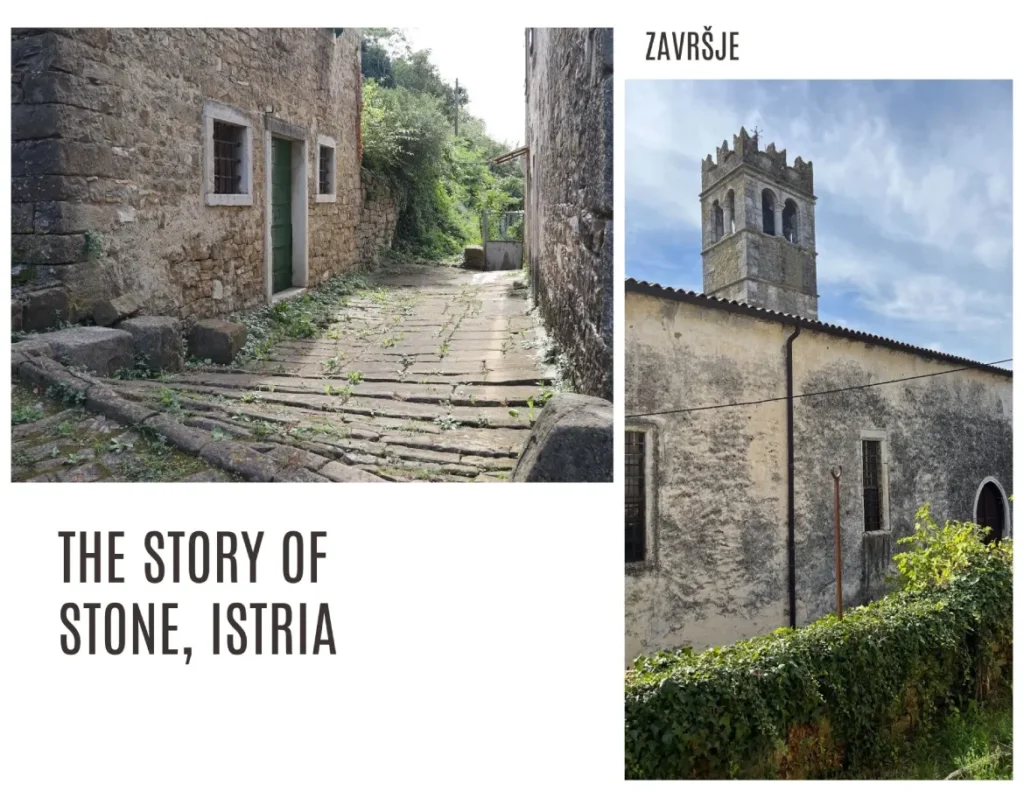
If it is open, you’ll notice a richly decorated interior. Look for the liturgical inventory, monumental sacrilege, and altar, wall, and ceiling paintings. The church has five altars, including one dedicated to the Virgin Mary. It features a unique image of Završje from the era when its churches were built. One of the most valuable things inside is the organ, dating to 1794 but restored in 1986.
The Završje Fort
As you reach the top of the hill along a stone-paved Romanic street, the Contarini’s Palace rises before you, just ten meters ahead. This impressive building commands attention as one of Završje’s most prominent landmarks. It retains its medieval architectural character. You can’t miss it.
The medieval city castle was built in the 11th century. It is known as the Palace of the noble Contarini. The palace includes an economic section, a residential area, and outbuildings surrounding the yard. It is assumed the Contarini family ruled Završje for three centuries.
See The St Mary’s Rosary Church
Just 10 meters from the Palace is St. Mary’s Rosary Church. It crowns the hill and was built in 1684. The church served as the Parish church until 1794.
The church interior holds valuable items and art. There is a tale about the calyx created by Zuanne Frintz and donated by Pietro Funes in 1476. The calyx was moved to the Rothschild family by the late 18th century. It now sits in the Louvre Museum in Paris.
Look at the Leaning Bell Tower (like in Pisa)
Don’t miss Završje’s landmark, the leaning bell tower. The distinctive bell tower of St. Mary’s Rosary Church stands beside it. It is 22 metres high and leans 40 cm to the north. Like the more famous Pisa tower in Italy, Završje has its own version. The stairs may be narrow and steep, so navigate with care. Check for seasonal hours, as visiting hours vary, and consider a small entry fee.
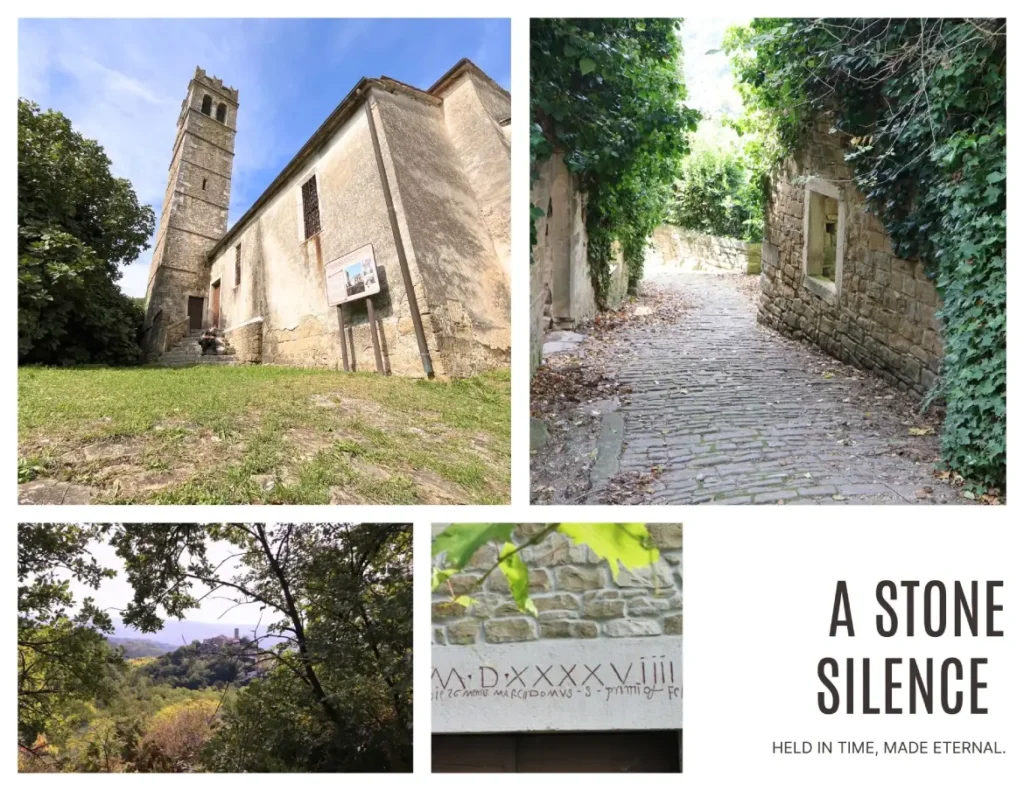
Climb it or not by the bell tower, but once you reach the hilltop of Završje, the whole panorama of the place spills dramatically before you. The view of the lush Istrian surroundings is even more stunning from the bell tower, with the landscape seemingly unfurling amid the surrounding buildings. Yet perhaps the best way to appreciate Završje is to explore it alone, since the town is exceptionally photogenic and resembles a fairytale, with its bell tower standing watch over the hill.
So you reached Završje’s highest point. You are all around the complex of a few abandoned houses without roofs from the 16th and 18th centuries. Given that the urban structure of Završje consists of buildings from the late Middle Ages to the 19th century, they have been recognised as having high historical and artistic value.
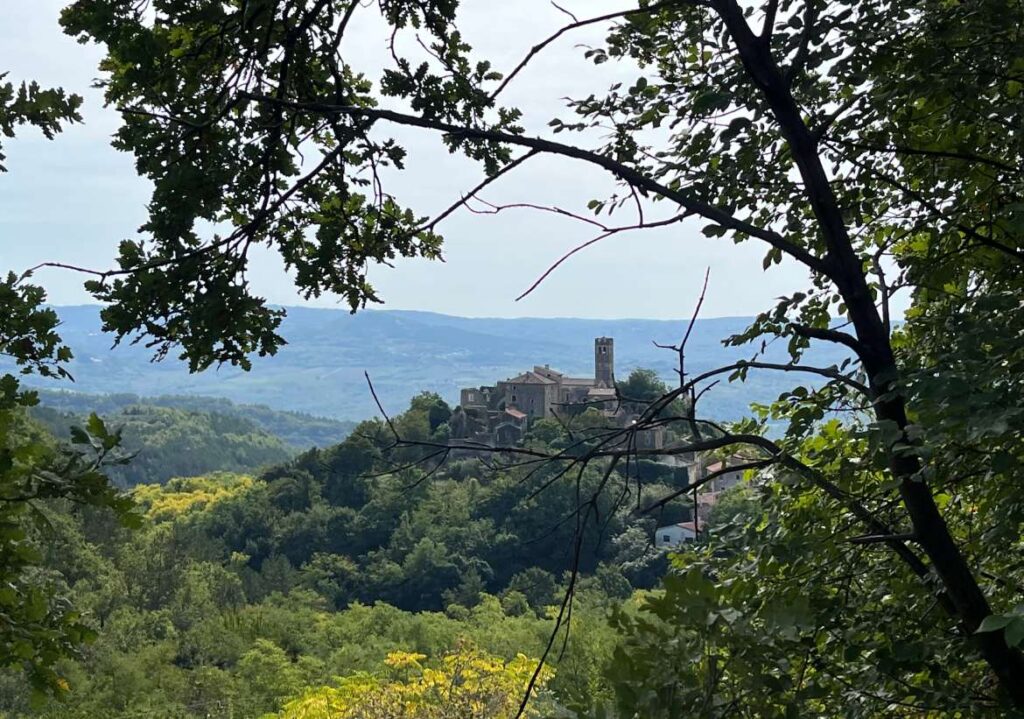
Take in the dramatic appearance of Završje, sense the Istrian past, capture a photo of the bell tower, and stroll the cobblestone streets that once appeared in the film Robin Hood. Enjoy exploring, and remember that Završje’s unique charm is ever-present.
Stroll through the Contarini’s Town Gate
Walking down the hill, you’ll reach the Contarini’s town gate. Located in the southern part of the town, it is also known as the South Gate. The built-in Romanesque style was preserved intact since the 1879 reconstruction, and it was fully restored in 2002. On the wall above the door is the Contarini Family Coat of Arms and a Roman Relief with Ariadne and Bakho, figures from Greek and Roman mythology.
See the church of St. Rocco.
The third church in Završje was dedicated to St. Rocco and is situated outside thewalls, near the town gate. The church was built in 1556 in the Gothic style and rebuilt in the 18th century.
Be active in Završje, central Istria.
Another noteworthy part of experiencing central Istria is hiking and biking. Završje’s surroundings have it all, and the excellent bike path runs along the Three Istrian Musketeers trail. Here, instead of just spotting trail markers or counting kilometers, you can breathe in the clean scent of pine and wild herbs as you pedal, or feel the crunch of sun-warmed gravel beneath your boots. Along the path, bursts of cicada song mingle with the hush of pine needles falling—a reminder that you are immersed in nature, not just passing through it. One of the most famous trails nearby is the old railway Parenzana, where each turn brings a new view and invites you to lose track of time in countryside silence.
Bike & Hike The Parenzana
Završje is already mentioned as one of the “Parenzana” 35 stationsof the former railway track that connected Trieste and Poreč. The Parenzana is an old railway line that has been converted into a walking, biking, and cycling route. It is a good idea to take a ride or hike while you are in Završje.
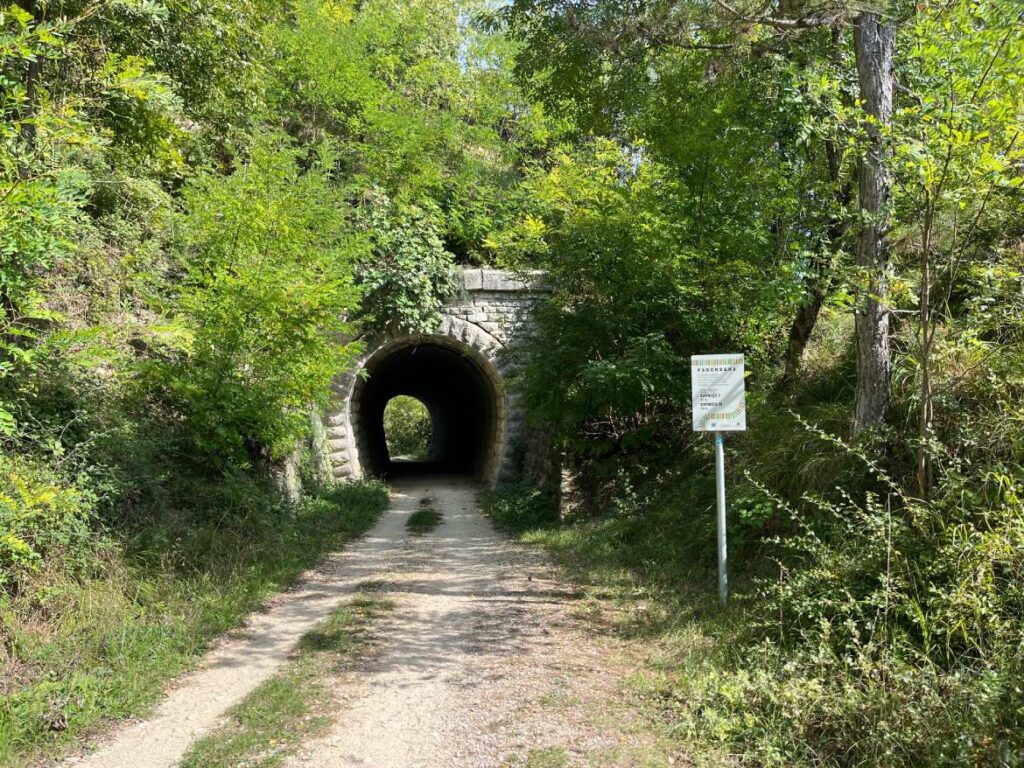
Every year at the end of April, countless families, couples, groups and singles take the 10-kilometre journey to enjoy the stunning scenery of Istria. So you can also do it by yourself even if you are not in Završje at the event Time.
Mountain biking to the Three Istrian Musketeers
The Tri Istarska Mušketira Cycling Trail is a mild-traffic loop route, 43.9 kilometres long. It presents an intermediate challenge, featuring gravel surfaces and two steep climbs. This trail runs through a wide woodland area and is quite challenging towards Oprtalj-Portole, Istria, Croatia. The track is mainly used for mountain and urban biking and runs along a section of the Parenzana.
Regardless of the starting point in Oprtalj, you can turn it on from Završje, and as it is circular, you will finish on the same topic.
Daily tours from Završje
Similar to the other Istrian hills, including those in Završje, which are not far away, such as Oprtalj, Zrenj, Buzet, Motovun, Zamask, etc. Završje is very often spotted by the daily tours themselves. However, every year more visitors choose central Istrian Gems, such as Završje, for their holiday, since they are surrounded by green areas and the surrounding area. Završje is undoubtedly one of Istria’s hidden gems, with its old-world charm preserved. It’s a must-visit while exploring central Istria. I personally recommend it as one of the top places to stop by in the area.
Getting to Završje
Hidden in the hills of northern Istria, Završje might feel remote, but reaching it is easier than it seems. Here are the main ways to get there:
✈️ By Air. Several airports connect Istria with the rest of Europe:
- Pula Airport – About 90 km away (1.5 hours by car). Pula is the main gateway to Istria and Croatia’s fourth busiest airport.
- Rijeka Airport (Krk Island) – Around 105 km from Završje (about 2 hours’ drive). Popular with low-cost airlines in summer.
- Trieste Airport (Italy) – About 100 km away, just over the border, above Monfalcone.
- Venice Marco Polo Airport (Italy) – 240 km away (roughly 3.5 hours’ drive). A good option for combining Italy and Croatia.
- Zagreb Airport – Croatia’s largest airport, 250 km away (about 3.5 hours’ drive).
🚌 By Bus. Public transport in Istria is reliable along the coast but less frequent inland. Buses to Završje are limited and primarily serve locals—so check schedules carefully, and be ready for a bit of adventure.
🚆 By Train. The nearest stations are in Buzet (30 km) or Koper (Slovenia). From there, you’ll need a taxi or private transfer, as train links to central Istria are limited.
🚗 By Car. The most convenient way to reach Završje is by car. Roads in Istria are well-maintained and scenic, making the journey part of the experience. Renting a car is highly recommended if you want the freedom to explore nearby villages, vineyards, and hilltops at your own pace.
🅿️ Parking. Cars are not allowed inside Završje’s historic core. Parking is available at several spots near the town entrance, with the main one located in front of the Parish Church. From there, it’s a short walk into the medieval streets.
Završje Info corner
📍Where it lies: Northern Istria, above the Mirna River valley, between Oprtalj and Grožnjan.
🚶Wander: Contarini Palace, leaning bell tower, old town gate, and cobbled lanes lined with abandoned stone houses.
⛪Sacred corners: Church of the Nativity of the Blessed Virgin Mary, St. Mary of the Rosary, and St. Rocco.
💧Hidden gems: The old Parenzana trail, viewpoints toward Motovun, and the ruins glowing gold at sunset.
🚲Slow path: Walk or cycle the Three Istrian Musketeers trail — a scenic loop through woods, vineyards, and quiet ridges.
🅿️Practical: Cars park below the old town; explore on foot. There are a few cafés nearby, so bring water and time.
🐐Trek Goat tip: Visit late in the day, when the light turns the stone honey-gold — that’s when Završje tells its truest story.