

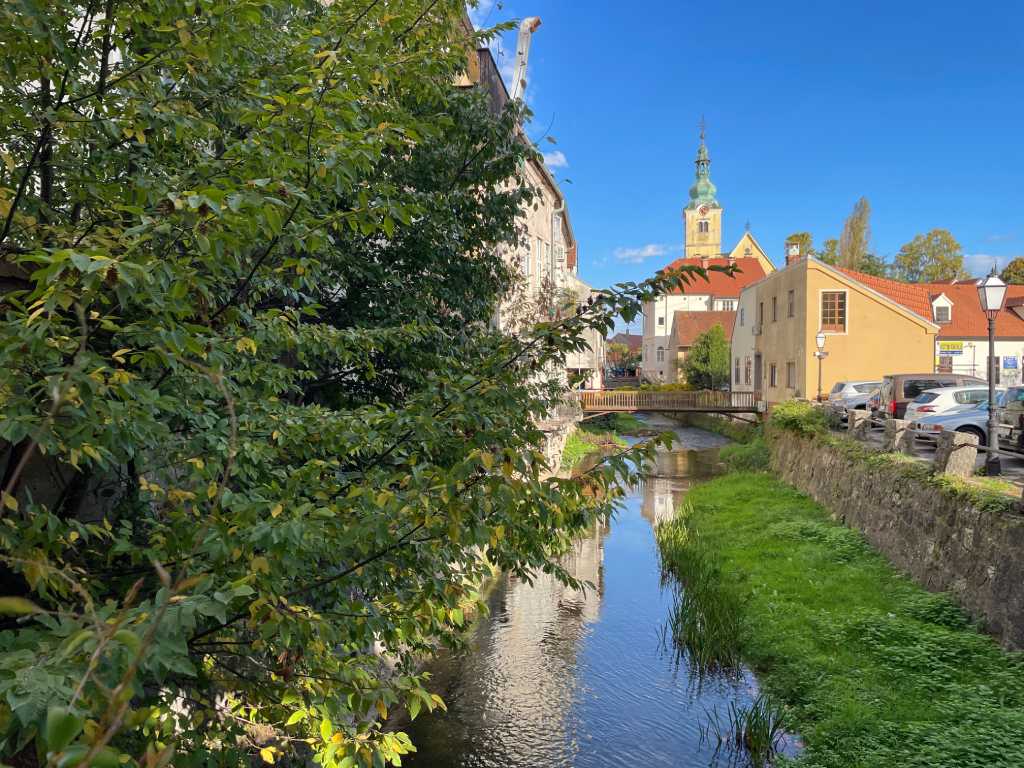
Located only 27 kilometres from Zagreb just next to the Slovenian border, Samobor is a place where one could dive in art, tasting the delicious desserts.
If I should choose which place of continental Croatia tells the story that will get you an inspiration at a glance, the site positioned at the foot of the green hills beside the burbling Gradna stream Samobor should be definitely one of it. As a result to be one of the best-preserved country towns of northern Croatia the place receives a steady stream of day-trippers from Zagreb.
If you’re in Zagreb and looking to escape the city for the day, set your sights on Samobor. When I come to Samobor for the first, it was the winter. It is the time when the city used to be decorated with the Christmas lights. And not only the city impressed me at a glance. It was a beautiful green scenery. The hills bound the place entirely, so I knew this I would for sure like always come back to Samobor, a lush of picturesque spots and vegetation.
Why should you visit Samobor
Samobor is a favourite weekend trip for Zagreb’s inhabitants, another well-preserved medieval city in inland Croatia. The city’s main draws provide classical arts and crafts. Still, it’s the fantastic cream cake “SamorskeKremšnite” that caters the visitors’ attention. The custard – coloured cream pastries made by local bakeries could be found in the café-filled main square.
Samor has all of the typical continental tiny European town elements as the square, medieval architecture and houses. Since you filling up the Kremšnite there is nothing else but walk by the beautiful, burgundy-washed dwellings and churches alongside the deep Gradna creek, as it runs through the town centre. But your rest half a day away from Zagreb to rest could be for sure be the whole day. Besides the city, there are numerous trails to hike. Outdoor lovers will enjoy a green path leading through the woods, making a good jumping-off point to all who want to get off from the daily crowds.
Samobor Walk 365
Samobor is a great city to explore by foot – in a hurry, you will reach almost every edge of the town for only about 20 minutes. But why you would rush alongside Samobor? Due to extraordinary climate conditions, it’s able to walk around Samobor gently and slowly all year around. And it would be not just a regular walk. If you want expire architectural, historical, romantic or relaxing vibe, Samobor has them all so you can choose between various of walk on your own. Sightseeing, recreational, romantic or children walk, all of each is particular but as final will give you the chance to expire some corner of Samobor. Choose someone you want to take.
Fans of arts and crafts will love Samobor since this city is a lush picturesque and tradition-filled by colourful houses and squares. Besides, it’s a perfect spot for a woodland stroll, too, with paths leading up to hillside Anindol before darting through the forest towards the too magnificent ruins.
Samobor sights
While tiny, there is a tremendous amount to enjoy in Samobor. Here we prepared some of the best attractions you should take a peek while in Samobor.
Stroll the Main King Tomislav Square
The central town square has been a landmark for locals and guests for centuries. The court used to call simply “Plac” by Samobor locals once also had the name “Leopold Salvator Square” honoured to the Austrian archduke. The present name got in 1925 on the occasion of marking the millennium of the Croatian kingdom.
Besides being the liveliest spot of Samobor, each building surrounds the central town square exudes the old times’ spirit. Take a look at the rich details revealing a vital past. A balcony number 14 is a place where once famous Croatian writer Antun Gustav Matoš used to spend its days writing. Furthermore, number 13 is a balcony where another writer Illyrian poet Stanko Vraz (born Jakob Frass; June 30 1810 – May 20 1851)on the street for the first time saw his unrequited love, Juliana Chantilly (found below the story).
There is an old well in the middle of the square, placed in its very centre dating back to 1764. There is a legend linked with a well, drinking water – whoever drinks water from it always returns to Samobor.The sign of hospitality has always been a glass of water. But in Samobor, a local Croatian song has it “Wine is drunk from pots”, so then the water is drunk from a well. Though we didn’t try it, I came back to Samobor many times after my first visit.
Get a walk alongside the medieval streets
Samobor Streets are amazing to walk through. Besides historical meaning, you can find many peaceful oases of nature in the middle of the city. Get alongside the old town and get a particular relaxing vibe. What impressed me is a well-maintained architecture that hasn’t changed for centuries. Walking around the fine pastel-washed buildings and churches will take you back in time. Just relaxes and enjoy this medieval – continental atmosphere.
Take a look on to The Parish Church of St. Anastasia
Located just above the main square, the Church of St. Anastasia was first mentioned in 1334, though the parish itself appears even earlier, in the 1242 charter of Bela IV. The current church, built next to the old wooden one, was completed in 1675 by the Italian architect Hans Allio, funded by Countess Ana Jelisava Auersperg.
This imposing building is considered one of the few early Baroque churches in Croatia, combining several styles and architectural elements. The church was consecrated in 1688, and its walls were painted in 1897 by Marko Antonini. It is the only church in northern Croatia dedicated to St. Anastasia.
Inside, you’ll find the ancient statue of the “Wounded Christ” (Kristuš), originally placed in a small 17th-century chapel near the main square well. The altars date to the 19th century, the remarkable stained glass windows to 1889, the Way of the Cross paintings to 1896, and the organ to 1900. The church is classified as Category II of exceptional value.
The bell tower, a city symbol visible from the main square, has been repeatedly covered with copper caps. Its bells were remelted into cannons during World War I and reconsecrated by Bishop Antun Bauer in 1927. From its elevated position, the church also offers lovely views of the main square.
Relax in Samobor City Park
Samobor’s centre is parks evoke a relaxing atmosphere and embody that old world charm.
Visit Samobor Museum and galleries
Though it is small, the museum located in a gorgeous green park has a little bit of everything; Samobor’s history, old documents, and art. You won’t need to take much time to pass through it, but it will show some exciting exhibits.Keep in mind that the museum is closed on Monday. Entrance fee is 15 Kuna for adults and 10 Kuna for children.
Besides the museums, Samobor is the place of the galleries. The leading site of the Samobor art life where the career of one of Croatia’s most enjoyable modern artists is celebrated makes Zlatko Price Gallery. Also with ground-making atFoto-GalerijaLanfthere’s a lot to make in.
Climb on to the Hidden Viewpoint above Samobor of Tepec
A viewpoint Tepec located significantly raised of the town, above the chapel of St. George, at 368 meters above sea level is definitely that one shouldn’t be missed away while in Samobor. The viewpoint is made by a self-luminous lookout equipped with meteorological equipment. It was placed on the former’s site. The wooden pyramid has taken care of in the 19th and early 20th century by the Society for the Beautification of Samobor and the Croatian Mountaineering Society Japetić.
The area inspired me at a glance. But I need to admit that the 14 meters high lookout Tepec (Anindolpyramid) I succeeded to overcome from the third attempt only. The pyramid was renovated by the Society of Engineers and Technicians of the City of Samobor No. It wasn’t the same day on my first visit. You’re on the right track, I succeeded to jump it after my third visit to Samobor! But I’m sure you can get it during your first visit!
Although the climb seems to look tremulous at a glance, most individual can do it with no special equipment. If you feel fearsome of the climbing strap that you could use as security could overcome it! Once you climb up to the viewpoint, you’ll enjoy one of the best views extending not only of Samobor but also around the area until Zagreb. Tip:
- How to reach it? A wonderful promenade of “Anin Perivoj” leads up to the viewpoint. But if you don’t have time or don’t feel yourself to hike you can just leave your vehicle by the church of St. George. There are required a few minutes, only up to the viewpoint.
- Climbing security. As we mentioned, it should take a little courage to reach the top because the construction can “dance”. Bear in mind the largest number of people who should enjoy the view of Samobor, Zagreb, Medvednica and SamoborskoGorje would not be more significant than 15.
MarkaVukasovićaViepoint to the city
Since Samobor is a city placed on hills, it has many great views over Samobor and Zagreb. Besides the most known we already mentioned, there are still many unique spots that visitors never discover. One of it is located in MarkaVukasovića Street 20, just above Samobor.
If You feel fair from the climb to the structure on Tepec we mentioned above, this viewpoint would be a good alternative that won’t take you much of time. And you can reach it just from the city centre. Becreative, talk to locals and ask for directions, to find the most exciting viewpoints.
Get to know about Samoborček Train
The famous Samoborček Train was a slow but beloved symbol of Samobor. Its slowness reflected the lengthy approval process under Austro-Hungarian Emperor Franjo Josip, which delayed the railway’s construction. Once completed, the train connected Samobor with Zagreb, reaching speeds of up to 20 km/h—often matched by people walking alongside.
The people of Samobor had requested the railway since the mid-19th century, and it finally arrived on January 14, 1901. Similar to Istria’s famous Parenzana Railway connecting Trieste and Poreč, Samoborček became a key driver of local tourism. Affectionately called “Peglica”, it became the favorite transport for excursionists and a symbol of the town’s romantic past, immortalized in Croatian director Krešo Golik’s 1970 film One Song a Day Takes Mischief Away.
Over time, the train was upgraded with single-engine aluminum carriages known as the “Silver Steels”, offering greater speed and comfort. Yet, financial unprofitability led to the last passenger ride on December 31, 1979. Today, the Samoborček train is preserved in Južno Naselje, with its locomotive and two carriages serving as a reminder that this legendary train meant much more than transportation—it was part of Samobor’s soul.
No wonder the Samoborček continues to appear in local songs and stories, a timeless emblem of the town’s charm.
Ferdo Livadić statute
FerdoLivadić also known as Ferdinand Wiesner (May 30 1799 – January 8 1879), Croatian composer was born in Celje. In present-day, Slovenia is located in the street bearing the same name and is honoured to him. Arriving in Samobor was allegedly decided by a love shipwreck, which in the end proved to be an excellent choice for both Ferdo and Samobor. Livadić hosted in his castle prominent representatives of the Illyrian movement was LjudevitGaj, LjudevitVukotinović, DragutinRakovac, PetarPreradović, Stanko Vraz, VatroslavLisinski and many others.
Due to hos first love a piece of music, Livadeć was visited by many foreign artists. So one of the guests he had was also the famous Franz Liszt during his visit to Zagreb in 1846, that (allegedly) played the Livadić piano.
Get a hike of Anin Perivoj
The area that immediately impressed me is known as “Anindol” or “Ana’s Promenade.” You don’t need to be an experienced hiker to explore this lush green space. Just a few steps from Samobor’s lively central square, you can step into the shade of the wooded hill Tepec, where peace and calm await along Samobor’s most beautiful promenade, Anindol.
This completely different world, yet so connected to the picturesque city, was envisioned by Samobor’s greats of the 19th century. They transformed this once-neglected space into a cultivated, yet natural retreat. Entering the shade of Tepec and Anindol, your perspective will shift dramatically—all just a few steps from the bustling town.
Samobor is truly privileged to have a woodland oasis right next to its centre. As you walk up from the town, you’ll pass beneath the canopy of trees, feeling the forest slowly envelop you. Along the way, you’ll notice the circular cabin and St. Anne’s Chapel (more on this sacred site below). What a stunning scenery!
The area was afforested by Ljudevit Schmidt, the mayor in 1865, who recognized that this natural space could serve as a social gathering spot while protecting the town from floods and erosion. Though I mention “hike,” this is really a gentle walk—a perfect way to experience the magic of Samobor’s woodland. No doubt, once you visit, Anindol will make you want to return again and again.
Get a walk of Samobor Calvary
Built-in 1933, Samobor Calvary is located on a slope between the chapel of St. Anne and St. George standing next to the Anindol viewpoint. There are 13 points of the Cross, work made by Fr. ElektMaruzi from Zagreb and crosses by the inhabitants of Domaslovac.
After that, you hiked it you can continue your walking “pilgrimage” forwards towards one of the magnificent hiking paths. Similar to Anindol, it’s also one of the gentle walks.
Location: Anindol, Samobor
Take a look Julijana Cantilly Grave and fond the story of
The legend has it the sung love of the poet Stanko Vraz. The beautiful local girl Juliana Cantilly gives a new dimension to walks around the city. A young Slovenian-Croatian poet Stanko fell in love at first sight when he saw the girl Juliana on her father’s house’s balcony. Right upon the saw Juliana at Nr. 13 King Tomislav Square (find above about the square), Stanko immediately turned her into the inspiration for a love poetry collection.
Though the love story did not have happy end since Juliana was married for a wealthy merchant from Ljubljana, and more ever she passed away at the age of 30, the spirit of Vraz’s tender feelings for her is kept alive. Those have survived by the poet’s colleagues who restored Juliana’s grave next to the parish church of St. Anastasia.
There are still the other statues and monuments in Samobor such as Monument to the unknown soldier erected after the WWII,Statue of the Mother of God or a Sundial dating back to 2015. And for sure each one has its story that I’m sure you’ll find by yourself.
Be active in Samobor
Another reason for visit Samobor out of looking the heritage is the outdoor activities. Samobor areas are a paradise for hikers and the fans of the other similar activities such as biking, running, trekking, walking, etc. Here I mentioned a few of the ideas.
Hiking& Biking. There are numerous trails in the area surround Samobor, and every time I come to Samobor, I discover a new one. Some of the courses I use to make every time I come to Sambor while others such as those longer I made will also be detailed in the other posts I shared via Putokoza. Yes, I like to hike Samobor Hills since there are lush of magic.
Local Hiking Tip 1:Get a walk to the Samobor Old Castle
Every look towards the hill of the Old Town of Samobor remnants calls to visit. Even though there are only hints left of it, the Old Town still attracts. It possesses the power to threaten the Samobor market for centuries and defended this area from foreign armies.
Though located on the hill in the middle of the forest above Samobor, the castle defaults are easily accessible from the city’s centre. You don’t need to be experienced hiker to get to the ruins of an old castle. The castle dates back to the 13th century. However, it will take you about a short 30-minute hike to reach the fortification, but totally worth it. Such an easy walk is perfect for clearing your mind and enjoying nature.
Numerous kings and nobles were the lords of Samobor over the centuries. The Czech king Otokar had it built in 1268, probably on an already existing building. The castle was ruled by Arpadovići, Babonići, Anžuvinci, Frankopani, Erdody, Celje, Matija Korvin, Ungnadi, Gruberi, Auerspergi, Kulmeri, Kiepachi, Alnochi and Montecuccoli.
Every year in March there is a medieval battle fair held under the hill where the castle is located. In Samobor Museum’s fair, you’ll see plenty of the exhibits linked to the fortification Middle Age. These are a military camp with fortifications, a medieval kitchen, and indestructible knights. Wandering the city reminding you of the erstwhile era.
Local Hiking Tip 2:Get a hike to Okić peak
A daily trip from Samobor to Okić Peak, crowned by the ruins of one of Croatia’s most forbidding medieval fortresses is one which offered me a lot of inspiration. Various ways are reaching Okić, and each depends on how many time you have and how much you are involved in hiking.
My favourite one what I made is the whole route with the full hike starting in Samobor. After a gentle walk of the Anindol Forest and climbing up to Tepec viewpoint we for sure didn’t miss the beautiful view extending of the Samobor area. After that, we take a hike across the magnificent woods and meadows of Samobor area walking trough the CerjeSamoborsko we reached Okić with the mountain lodge. The Way Back to Samobor was a little longer circularly alongside Kladje, VelikaRakovica& Mala Rakovica.
However, if you don’t feel yourself to hike the route of 19 kilometres you can reach Maks Plotnikov mountain lodge located in foothills of Okić by car. From there till Okić medieval castle is 15 minutes of walk only.
Local Hiking Tip 3:Take a hike to Japetić Hill
Not only for Samobor but also a favourite spot for Zagreb locals,Japetić Hill (879 meters), the highest point of SamoroskoGorje hill range attracts mountain climbers and hikers since the beginnings of organized mountain climbing in Samobor.A two-hour walk from ŠoićevaKuća, a popular restaurant and recreation spot would be enough to reach JapetićHill. The beech forest is protected in 1975 as a nature reserve, the hill that is located above the enchanted wood.
On the very top is located a 2-metre high “pyramid”, erected in 1960. The view from it is stunning extending ofnorthwestern Croatia, some parts of Slovenia, and if you’re lucky with the weather even the Alps. Since the climb to the peak is considered a gentle hike, Japetićhas becomeone the most frequently visited mountain locations ofSamobor area. Nature surrounds the mount is extremely rich with meadows and forests, with numerous protected and endangered plants.
Daily trips from Samobor
Due to its location, Samobor offers various things to do and places to visit in its surroundings. Whether you wanted to spend your day, walking alongside nature, seeing the history or just relaxing, Samobor area has it all to offer!
Samoborsko Gorje / The Samobor Hills
In the very vicinity of SamoborSamoborskoGorje was born. The Samobor Hills a small group of heavily forested smooth-topped mountains that make an ideal day trip (see above) targets for the recreational hiker.
The highest point of SamorskoGorje is the 879 meters Japetić. Making the south-eastern extent of the range is the steep-sided summit of Okić. Both of the topics are mentioned above on a hiking trip.
Žumberak Hills
One of the central unspoiled highland regions within a day-trip distance from Samobor, Žumberak is among the most alluring. In many ways extension of the SamoborskoGorje, the Žumberak consists of a succession of high ridges, narrow valleys and isolated villages filled with corn-drying barns and piles of chopped firewood.
Plešivica
Spreading across the southern limbs of the SamoborskoGorje, the straggling village of Plešivica occupies a beautiful landscape of undulating hills ribboned with vineyards. Alongside excellent Pinots, Chardonnays and Rieslings, the area is also renowned for its Portugizac, a fruity red wine – that rather like Beaujolais – is best drunk when young.
October is a significant cause for local celebration. Many Plešivica vine-growing families offer the chance to taste their wines, often accompanied by cold cuts of meat and cheese.
Grgos Cave
The most dazzling cave in northwest Croatia as some use to call it, Grgoš cave has two halls, both 30 meters long, with a large crevice, and 19-meters high. The shelter located at the entrance to Otruševec, only 10 minutes far away from Samoboris a protected geomorphologic monument of nature.
The cave is bearing the name after JospiGrgoš who discovered it accidentally in 1973. He set out in search of the raw material for extinguishing lime. He stumbled upon an underground treasure – a 30-meter-long, 19-meter-deep, sigma-rich cave with two halls. Due to its rich cave decorations, the cave has been declared as protected geomorphological Monument of nature. No matter if you re involved in speleology or not, the cave is definitely an attraction you shouldn’t miss. The entrance to one of the most known tourist attractions of Samobor is just about 15 Kunas for adults 10 Kunas for children.
St Barbara Mine
The centuries-old mining tradition in the area has left behind miles of trenches. Almost all of them have been forgotten. However, one of them makes a different story. The Saint Barbara Mine is only a 15 – minute drive away from the centre of Samobor and was renovated in 2002.
The mine located in the forest shade above Rude’s town is considered one of the oldest European copper and iron mines dating back to 1481. Although there are no more miners who extract copper and iron, the mine lives again through tourism. Therefore if you are a fan of the underground, do not hesitate to come in. With expert guidance, you will enjoy the full experience of authentic mining space. Besides, there could be walking alongside the darkness and cold of the Holy Trinity and “Kokel” trenches, passing through 350 meters of underground tunnels that are several centuries old.
Local legend has it the mine is inhabited by “Bergmans”. These dwarf creatures walking through the former mining trenches once interfered with the miners interrupting them in their daily tasks. So be careful! Who knows what something else could be found there!
Cerinski Vir Waterfall
Hidden in the woods, and due to recently difficult roads separated from the urban area, a noise of water heard before reaching a cleft down will uncover a magnificent 10-meter waterfall flowing. The most picturesque waterfall of the Samobor hills is located in JavoračkiPotok’s canyon, next to VelikiLipovec. It is gorgeous in spring and autumn, when the stream is rich in water, while it can dry out in summer.
The waterfall hiddenfrom the view for a long time was foundby local mountaineers who accidentally came across it in 1927, after returning from a trip to Japetić.
How to reach it:
By car. Drive to VelikiLipovec. The waterfall is located next to it.
Vranjački Waterfall
A legend has it this waterfall in wintertime resembles the crystal white hair of a mountain fairy. The canyon is in Slapnica stream, which got its name from the numerous waterfalls and cascades through which the water descends through a narrow deeply cut valley. The valley uses to be 10 km long this 15-meter high waterfall enchants with its beauty, surrounded by tufa. This “living” rock is still formed today.
Vilinske Jame (Fairies’ Caves)
Located above the Breganica stream, not far away from Slani dol village, many small caves circulate. The caves bearing the name about the fairies were created by the sedimentation of limestone. The water from the tributary was dripping down over a steep rock into the Breganica stream.
How to reach it:
By car. The easiest way to reach the caves is through Slani dol, following the Breganica or Višnjevac stream’s valley. They are an ideal starting or passing spot for longer excursions into Samobor or Žumberak hill range.
Varaždin
Also known to be a baroque city, this impressive old town offers an experience to stroll over the fairy tale cobblestone streets bounded by the luxurious churches, town manor houses, the cemetery and particular the old white-red coloured castle.
There is an Aqua city recreation centre as the local hub for summertime entertainment and water events. At the same time, the Varaždin environs have a wealth of nature grounds and fishing spots.
Krapina
In addition to being famous as home to Europe’s most extensive Paleolithic site housing, the fossil bones found in the area belonged to Neanderthals who lived 30,000 years ago. Krapina is picturesque and bounded by incredible green landscapes. Prehistoric remains found on HušnjakovoBrdo that has become known as “KrapinskiPračovjek”. Just outside DragutinGorjanovićKramberger 1899 was made Krapina one of the wealthiest Neandertal sites in Europe. It’s about 45 minutes far away from Samobor.
Veliki Tabor
The castle dating back to the 15th century is now a compelling Renaissance museum furnishings. Built to serve for the Ottoman defence, the court was adopted for residual purposes dating more peaceful times. Renaissance-style arcades were added to their inner courtyard. With a vast barrel-shaped bastion sprouting skywards from a green ridge, the castleVeliki Tabor serves as something of a trademark for the whole Zagorje region. It’s one hour and 15 minutes far away from Samobor.
So here we noted only a few of the ideas you can make while in Samobor. If you’re interested in getting more attractions in the area, look at this post about Zagreb’s daily trips.
Krašić
Being a home of Alojzije Stepinac (1898-1960), the archbishop of Zagreb, Krašić has become a symbol of spiritual resistance with having a small museum telling a life story of the bishop in an accessible style.
Samobor events
There are no doubt the key festivals all year round. Still, however, the event that has made a place to be known local and international is Carnival – SamoborFašnik.
Samobor Carnival – Fašnik
Suppose you’re in Samobor/Zagreb around the beginning of February. In that case, you shouldn’t miss visiting one of the oldest carnivals in Croatia has been holding at least since 1827. During this event honoured about the Carnival traditional locally called “Fašnik”, Samobor is particularly lively. The main square and all the streets around it are crowded in masks, costumes, and exhibition.
The week-long streets and music fashions lead till the Tuesday Shrove. Then carnival fun is congregating on KraljaTomislavaSquare, with Prince Fašnik ‘s burning effigy (Carnival Prince). The welcome ceremony is in honour of the spring sorrows and due to suffering exile. If you’re interested in getting to know furthermore about Fašnik Carnival, Take a look here.
Spring Fair
At the beginning of spring, this event organized every year merges together the crafts’ tradition and the locals’ hard-working hands. So if you’re in town at that time, you shouldn’t miss the Spring Fair that gathers the best of the town’s crafts tradition, family production, and cultural and gastronomical offer.
Cufus Street Art Festival
Cufus is the most known circus street festival in the region that takes place on streets, parks, and squares of Samobor. Merging together local and international street artists it makes enticing playful conduction for visitors of all age. You can get involved in workshops, taste some local meals or drinks. Simultaneously, the King Tomislav Square will be filled by the manufacture products, handcrafts and gastronomical specialities.
Samobor Town day
Every third Saturday in October the locals organize Samobor Town Day in honour to the event in the town’s history dating back to 1242. That year Croatian – Hungarian King, “Béla IV”, gave Samobor a charter by which the city became a free royal town. Having the alliance meant the people of Samobor were independent, free trade of their assets, and choose the priest they wanted.
The chapels and churches of Samobor
As previously mentioned, Samobor is a city with the continental impact of the various periods, so there are many sacral objects founded in the town and next to it. Besides the parish church St. Anastasia we already mentioned here we listed the other sacral buildings of Samobor.
Take a look the Chapel of St. Michael (KapelaSvetogMihalja)
Many locals would admire this mysterious church is the most marvellous in Samobor, and certainly one of the oldest. The church located at the foot of the Old Town is a typical example of a Gothic chapel. Still, it’s considered SvetiMihalj on Taborac has been a place of prayer for the people of Samobor probably so far in 13-the century. This evidences the Romanesque-style window and the wall paintings with medieval crosses that were discovered during the research.
The church got the Baroque elements in the 17th century. Those baroque altar has been preserved, while the image of St. Michael the Archangel is one of the earliest surviving from the early Baroque. The main altar is dedicated to St. Michael. It is the work of Ivan Komersteiner dates back of the turning between 17th to 18-the centuries. The church location has historically been the scene of conflicts between the inhabitants of the market town and the nobility. In contrast, in recent times it has been a gathering place for Samobor poets at the annual meetings “At St. Michael’s”.
Admire The Chapel of St. Anne and feel like in Fairy-tale
Located in a scenic area of St. Ana Promenade, Chapel of St. Anne, bearing the same name as the church, is considered one of the most known Samobor chapels. This is probably after the young Marko Vukasović song in 1937, as a gathering place “At the Chapel of St. Anne”.
When I saw the church for the first time, the sensation overwhelmed me to feel like in a fairy-tale. The chapel bounded by the lush of green, located in the forest’s peace on Tepec Hill, is considered the youngest of Samobor’s baroque sacral buildings first mentioned in 1677. However, it is assumed the work on its construction began earlier
The official year has carved behind the main altar and on the bell is 1751. It is considered that its construction was paid for by the Counts of Auersperg. The chapel has 3 altars decorated with Baroque paintings from the 18th century and has been renovated several times and classified in the II. category of artistic value.
Location details:Tepec Hill, Samobor
St. George Chapel
Located on Tepec Hill, the chapel is believed to have been built with voluntary contributions from the winegrowers of Giznik and Mala Rakovica, on the site of an earlier sanctuary. The local devotion of Samobor residents to wine and viticulture inspired the construction of the Chapel of St. George.
The chapel is estimated to date back to themid-16th century, with construction completed around 1620. Work continued until 1799, when the masonry tower was finished.
According to local legend, the chapel miraculously appeared on this site without a foundation. It was cared for by the Brotherhood of St. George, but the Baroque altars, paintings, and furnishings were destroyed by fire during World War II. The chapel remained empty until 1967, and in 1992, it underwent a detailed renovation organized by the Brotherhood of St. George.
Location details:Tepec Hill, Samobor
Chapel of St. Helens
The oldest chapel of the Samobor Parish was originally associated with Prince Ivan of Okić Hill, granted by the Croatian-Hungarian King Ladislav in 1274. There is no definitive evidence of who exactly built the chapel or when, but it is connected to the oldest monastery in this part of Croatia, mentioning a Cistercian abbey in 1277—so it may be even older.
At the end of the 15th century, the Cistercians had to leave Croatia due to the threat of the Ottoman Empire, and their possessions, including the Chapel of St. Helena, came under the rule of the Zagreb Chapter. Over time, the chapel fell into decay, and by 1831–1832, it was in such poor condition that it had to be demolished.
The current chapel was rebuilt in 1925 on the site of the former Cistercian monastery, thanks to the efforts of Samobor teacher and chronicler Milan Lang. Today, it is cared for by one of the youngest fraternities in Samobor, the Brotherhood of St. Helena, and a large gathering takes place every year on the feast of St. Helena the Crusader.
Location details: St. Helena, Samobor
Franciscan Church of the Assumption of Mary and Franciscan Monastery
The wooden monastery dates back to 1618, while next to it was the old Gothic church of the Blessed Virgin Mary in Field. It is believed the church is built by King Bela IV. as a sign of gratitude to the people of Samobor. It is the oldest masonry building in Samobor. The Franciscans came to Samobor in 1525, but they did not settle down until the 17th century after starting a school and founded the first pharmacy at the beginning of the 18-the century.
Since the wooden monastery was destroyed in fires several times, the significant renovation began in 1712. According to the parish church’s floor plan, St. Anastasia, a church in the Baroque style was built next. A rich artistic and precious Baroque inventory and works of art are inside the interior. Over the interior dominates the monumental illusionist fresco in the sanctuary depicting Mary’s Assumption, painted in 1752 Slovenian master FranjoJelovšek.
There is a meeting house Tabor within the church, which organizes spiritual renewals and seminars, so the Franciscan monastery in Samobor has become a spiritual tourism centre. A valuable library was in a sanctuary, that was for several times built as a hospital, where the French army stayed during the Napoleonic conquests.
Location details: Langova 16, Samobor
Parish Church of St. John the Baptist
The church of a classical shape with neoclassicism elements next to a tower that is 35 meters high is known by the bell weighing 788 kilograms. It is dedicated to St. Anastasia, which was donated by the City of Samobor. Behind the main altar, there is a stained glass window with the image of St. John the Baptist who baptizes Jesus, who gave the pres. Tomo Petrić.
Location details:.Bistrec 38, Bregana
Putokoza local tip for Samobor:
As we noted in this post, there are so many things to do and see in Samobor. However, as many how long you discoverSamobor, something is hidden in it could still be found. Something that you haven’t yet expired or revealed. So below, I wanted to share with you some of the suggestions.
Find some Tradition & craft products or a souvenir
You simply cannot come to Samobor and not find some handicrafts, souvenirs or not make some deal. Samobor is a city of handcrafts. It’s assumed Samobor first handcrafts date back as early as the 16th century. From that time the number of craftsmen in Samobor has always been of significant manner. According to the historical files, 148 craftsmen from 28 different occupations were recorded in 1754. No matter what kind of craft millers, tanners, hatters, bootmakers, glaziers, locksmiths, blacksmiths, bakers, crystal production, Samobor has been a city associated with them for centuries. Can you believe, in the 19th century almost every third local from Samobor was a craftsman of some kind?
Though some of these occupations died out over time, some are still alive or changed due to economic transformation. Many small products are still manually produced as a family business, such as glass, ceramics, crystals, gingerbread, candles, hand-painted souvenirs, metal fences, wooden doors, cosmetics, gastronomic packages with local specialities. Take a walk and find someone!
Get for a romantic walk
Samobor is a place made for romantic walks. Therefore, if you are travelling in a couple, you shouldn’t miss a gentle stroll alongside Gradna Creek’s promenade. There you will find an ideal place for taking a photo for two. One of the avenue points is recognized as “Samobor Venice”. So let’s see it!
Before you start the climb head towards the Old Town, you can lock your love on a fence adorned with love padlocks. Upon return, take a sit in one of Samobor eateries. Each of them is good, so I’m sure you’ll endorse that love goes through the stomach!
Get to know about The Turtle below the Old Town
The thing you probably haven’t known (neither do I) is a natural phenomenon, a rock at the foot of the Old Town, gave birth to the legend of the Samobor turtle. The code has it the stone in a shape of the turtle dates back to the 15th century. At that time this great turtle was created by the Countess Barbara of Celje, the ruler of the Old Town and the famous Black Queen who, practising alchemy and harming the people of Samobor.
Eat & drink
A continental European impact enabled to Samobor area to develop a lot of gastronomical foodstuffs. Let’s see what should you try.
Samobor cream cheese
One of the main reasons the locals and tourists visit Samobor is they could taste SamoborskeKremšnite (Samobor cream cheese).The custard-coloured cream pastries made from eggs, milk and flour is produced by all the local bakeries. Often called the Queen of the cakes by locals, Samobor cream cheese is a symbol of the city and is usually topic in songs and books. So it seems there is nothing more to add than you should taste this speciality made of a delicate light yellowish cream between the crispy puff pastry. Not to taste only, this is souvenir required to take with no matter if it comes cold since you can find it in every pastry shop. Take a look for further more details here.
Bermet and Muštarda
Samobor is famous throughout Croatia for two culinary curiosities, both of which are thought to date back to the short period of French rule at the start of the 19th century. The first written document on vineyards in Samobor dates back to 1277 stating that the Duke of Okić gave the Cistercians three vineyards in Jelenščak.
Most famous are Bermet (the local version of “Vermouth”,a fortified wine flavoured with citrus fruits and aromatic herbs, most notably wormwood. Less of an acquired taste is Muštarda, creamy brown mustard with a robust fruity tang.
Getting to Samobor
Samobor is well connected to Zagreb, Croatia’s capital, and is only 27 km (about 30 minutes) away.
✈️By Plane: Zagreb Airport (Franjo Tuđman) is 45 km from Samobor, roughly a 30–35 minute drive. From the airport, you can continue your journey to Samobor by car or bus. Airport info: +385 1 6265 222, ZAG Airport
🚌 By Bus: The Samoborček bus service connects Samobor with Zagreb’s central bus station and the “Črnomerec” station. Tickets can be purchased directly from the driver. For more flexibility, consider a private transfer, which is affordable and avoids waiting for buses, starting at around 340 HRK one-way from Zagreb. Bus info & reservations: www.akz.hr
🚆 By Train: To reach Samobor by train, travel first to Zagreb’s main train station (King Tomislav Square 12, about 10 minutes’ walk from the city centre). From there, continue by train to Podsused station and then take a bus to Samobor.
🚗 By Car: Samobor can also be reached via several international routes:
- Trieste → Ljubljana → Samobor → Zagreb
- Graz → Maribor → Zagreb → Samobor
- Klagenfurt → Ljubljana → Samobor → Zagreb
- Budapest → Varaždin → Zagreb → Samobor