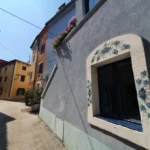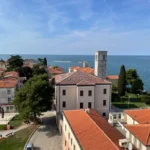

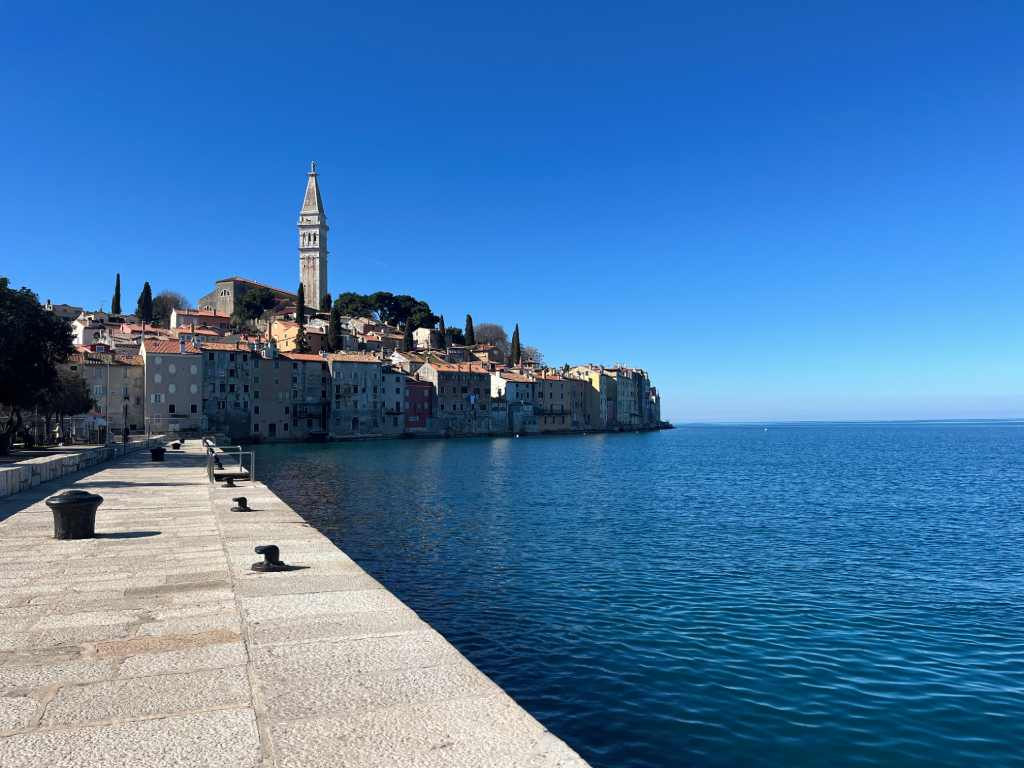
Stricken in a time, with cobblestone streets and houses touched by Venetian elegance — the legacy of the medieval Serenissima — Rovinj feels at once ancient and alive in the present.
On the western edge of the Istrian peninsula lies Rovinj—a town that feels more like a story than a destination. Cobbled alleys, pastel-colored houses leaning toward each other like old friends, and the constant murmur of the sea create an atmosphere that quietly insists: slow down, you’re already where you need to be.
Life on the island of Mons Albanus began in the 3rd century, when the first gentle traces of a town slowly took shape. Although it will appear with the original Roman name Castrum Rubinium or Arupinum, unlike Poreč and Pula it will not have significance at that time. But this does not mean that it will not share the later fate of Istrian towns and bypass the Venetian government. A mystical era of the medieval Venetian Republic actually left the greatest trace of its past. For this reason, today Rovinj tourist brochures are often called ” Venice in miniature “.
The picturesque town is today one of those places that hide stories of unknown sailors and fishing tradition. It is no coincidence that Rovinj was named one of the most beautiful coastal cities in 2014 by ” Travel and Leisure Magazine “. Putokoza reveals Rovinj to you, saying that the town on the west coast of Istria is full of incredible sights and is waiting to be discovered. Putokoza blogger knows a lot of them, because this is the city he comes from!
A walk through Rovinj – a walk trough the past of the Venetian heritage
Although Rovinj does not differ much from other cities on the west coast of Istria, such as Umag, Piran, Koper, various influences have created a specific appearance of the former medieval city. His houses are stacked on top of each other like children’s toys, whose Mediterranean charm hides stories and legends. Stone, winding and often steep streets are surrounded by buildings, which are characterized by different styles, from Gothic, Baroque, Renaissance to Neoclassical.
Upon entering the city, the visitor will feel the fusion of the sea, the spirit of the past, and Mediterranean herbs, will stimulate the desire to walk, create, inspire… And really narrow streets, as if invoking art. Curving along the coast, next to the rocks and reefs with the eternal noise of the sea, they will reveal to us still untold local secrets.
From the industry to tourism
Rovinj used to have several factories. The most famous production in Rovinj was the production of fish and tobacco. Mirna factory still produces fish, making Rovinj one of the biggest exporters in the region. At the same time, the tobacco factory transformed its halls outside the town to Kanfanar village. Former halls of the tobacco factory used to serve for events.
Picturesque streets and a breath of the past
Grisia, which bears a name similar to the town of Grožnjan in northern Istria, is the queen of the streets. The same, in which we feel the breath of art and the past of medieval times, is a real artistic oasis. The winding street connects the main square on the coast with the church of St. Euphemia at the top of the hill. In August, Grisia becomes the ” Gallery under the Stars “, a 40-year tradition. Located in the northern part of the city above the city market, Švalba Street connects the city market with the Monte zone. One of the attractions that is impossible to miss is Carrera Street . Filled with boutiques, she is always filled with life.
Venetian legacy sights
The Mediterranean pearl has many attractions. In fact, there are so many charming points that you will always want to come back to it. Once a peninsula, today a city of inspiration, it is perfect for discovering. And the town has a lot to discover, what was hidden at first, invisible. Venice, that is, the former “La Serenissima” ,” La dominante” as it was once called in the Mediterranean, has certainly left the most traces in Rovinj.
From the once seven city gates, the remains of three entrances from the 1700are visible today. The most famous is Balbi‘sBow. An 18thcentury Venetian lion with an open book suggests that the entrance was built in peacetime. Beneath the lion are symbols of the Balbi family, who built the city gates (1679) by tearing down those next to the “old fish market”. Just a few steps away, on the left is a red building. The old Praetorian Palace, built in the early 14th century, is today a town hall, and was once used as a prison.
However, the Venice era also brought risks. When in the night of 1597 the Uskoks from Senj attacked Rovinj, which was then under Venetian Istria, the city was significantly damaged. Rovinj is recovering but is not avoiding the plague epidemic, which was fatal for the not so distant Dvigrad . In 1775, the city had more than 10,000 inhabitants, and in 1763. a canal is dug between land and sea.
The main square and the house of Batana
From the first half of the 17th century the square called ” Piazza della Riva ” becomes the main city square (today’s M. Tito Square). Along with the fountain with a sculpture of a boy, the square is dominated by a sundial from the 19th century. Rovinj still has a Mediterranean hotel. Adriatic, the first hotel in the city from 1913, completely complements the traditional look of the square.
The town square is also home to a baroque palace that belonged to the Counts of Califfa during the 17th and 18th centuries. Today it houses the city museum. Founded in 1953 by local artists, the museum has a collection of permanent exhibits and art presentations. Rovinj is still true to tradition. This is evidenced by the museum ” House of Batana “, not far from the square next to the Great Pier of the customs pier.
Housed in a 17th-century building, it tells the story of a batana, a flat-bottomed boat without draft. We also see Batana in Fažana. Once you have mastered “build a batana”, It’s time to sail the sea and take photos of local fishermen. Capturing them into the lens at sunset, there is no doubt that the photos will turn out beautiful.
City Market and Theater
It is almost impossible to be in Rovinj and not get to know the local customs. And for the same it is best to go through the city market. In addition to fish, for which Rovinj is best known, there is also a wide variety of foods based on olive oil and vegetables. The building known as the Gandusio Theater dates back to 1854. It was designed by Nicolo de Callifio, the then mayor.
Rovinj offers more wandering around
Since the surroundings of Rovinj are rich in green vegetation, it is an ideal place for lovers of nature and outdoor sports. The geologically preserved archipelago has been a cultural monument since 1963.
Islands of inspiration
If you ask me which of the Rovinj islands I recommend, I will undoubtedly tell you that each of them is full of greenery and karst special. And of course we can write an individual story about any of them, as they deserve it! And yes, each is mystical with its invisible secret stories and legends. Rovinj’s car-free islands are a jewel of the Mediterranean.
The island of Sv. Ivan (San Giovanni) is a discovery of inspiration. It is rich in Mediterranean vegetation and an interesting past, as evidenced by the small church. The picturesque island with cliffs is a real oasis of peace. The other island of Banjole is a small rock. Local name and “Seven Hairs“ signifying that there are seven trees is often the place of diving trips to the cave in the center of the island. If you are like the Putokoza/Putokoza team, a lover of adrenaline, this small island has it all: a rocky coast and a magnificent underwater world suitable for scuba diving.
Every day during the summer months, small boats connect Rovinj with the two islands of the Rovinj archipelago. You need to find some of the hidden coves, promenades, secrets or monuments dedicated to unknown sailors. One of them is located on the most famous Red Island (St. Andrew), but where exactly, I let you find out. With an abundance of forest vegetation, which is known as one of the most famous green oases in Istria, the island has spectacular views.
The most beautiful is perhaps the lookout from the stone pillar, just above the small fortress – the Castle. It was built by Count Hüetterott. The island of Sv. Katarine, only a five-minute boat ride from the city, hides rocky cliffs and the shade of the forest. The island was forested by the Polish Count Milewski.
St. Pelagius
A wonderful complex of Austro-Hungarian buildings located on the peninsula of St. Pelagius, in the northern part of the city is part of the Martin Horvat Hospital. Surrounded by an evergreen forest, the area is ideal for a walk by the sea. The highest point of the peninsula is the Austro-Hungarian fortress, a former lighthouse. Surrounded by trees, the building does not have such a spectacular view, but allows you to enjoy the lush forest of pine vegetation.
Golden Cape – Punta Corrente
The fairytale area, located about a twenty minutes walk from the city center exudes greenery of oak, olive, pine, promenade and sea. The Zlatni rt Forest Park has been considered the first protected area in Istria since 1948. It was afforested during the reign of Count Hütterot, at the end of the 19th century. Climbing enthusiasts will find great directions to practice here (even 5!). Aren’t you a climber? Do not worry. Embark on a simple hike discovering places of hidden views of the horizon, the secrets of the quarry, the scent of the canopy of indigenous pines, evergreen oaks and exotic cedars.
Be active in Rovinj
Yes, there are many activities you can click and do in Rovinj. I will mention some of them here.
Jump on two wheels. There is no end to the surrounding places where you can ride a bike in Rovinj. The coastal cycling route to the south to the ornithological reserve is especially famous and numerous courses to the north and inland to RovinjskoSelo. It is easy for the whole family, including children. If you want something a little harder, you can still find bike paths around Rovinj, with different degrees of difficulty. Routes through RovinjskoSelo, Lim Channel (Lim Channel), Bale, ornithological reserve Palud are some.
Kayak. For those who like sports or water activities, there are opportunities for kayak tours in Rovinj. Tours range from 9 kilometres of travel around the islands to 14 kilometres to the Lim Fjord. There is a possibility to rent scuba diving equipment.
Running and walking trails. There are many of them. From crawling along the coast, merely walking through the golden cape, Škarab, the northern part of the city to the more complex ones in the Lim Channel. Investigate them!
Rock climbing. The old quarry is the best place to climb.
Diving and scuba diving. There are so many offers, and you will find a diving centre located in various parts of the city. Rovinj is one of the most famous diving oases that hides the famous “BarunGautsch” or the hidden and legendary “Cissa” (see below in the tips for more details). The most renowned diving centre is Scuba Diving Center Rovinj s located on the north coast next to the former train station.
Play tennis. Numerous tennis courts located in resorts and hotels allow tennis fans to enjoy tennis.
Daily tours from Rovinj
The excellent position of Rovinj facilitates the exploration of the Istrian peninsula and feels the diversity of the region.
Take a look at the Roman Arena in Pula
The largest city on the Istrian peninsula offers a rich itinerary of its three thousand years old history. It is a multitude of diverse attractions for culture lovers. If you are looking for events, monuments or museums, Pula is the right choice for you. You certainly do not want to miss the old city landmark, the Roman amphitheatre, because your every step in Pula leads to it. Go back in time and see why Pula is Croatia and Rome is Rome. Here’s how to get there.
- By bus: There are several bus lines between Rovinj and Pula, almost based on local transport. The ride takes about 45 minutes.
- By car: follow the direction to the south. Pula from Rovinj takes more than half an hour drive.
Look for dinosaur tracks in Bale
Bale (also Valle) is a picturesque tiny town 15 kilometres far away from Rovinj. It will enchant visitors with its architecture, churches, and dialects spoken by its Romanesque inhabitants’ descendants. Apart from the familiar Sorado Bembo castle that dominates the place, there are few impressive Venetian features such as loggias and gates. But you probably didn’t know that the Bale area hides dinosaur tracks, and they’re from the real thing. Let’s find them:

- By car: Bale is only a 15-minute drive from Rovinj
- By bus: There are several bus lines between Rovinj and Bale, almost based on local transport. The ride takes about 15 minutes.
Look for hidden secrets in Dvigrad
Historians and the remains of cities will find a medieval fortress’s impressive remains that stretched on two hilltops and had 2000 inhabitants. The plague is considered fatal for Dvigrad because only a few families lived in the 17th century because of its outbreak. Although the city centre has a square, it is known for an event showing the medieval tradition. One could visit it in early summer. How to get to Dvigrad from Rovinj:
- By bus: there are several lines a day from Rovinj to Kanfanar. From Kanfanar you have to go down to Dvigrad.
- By car: Dvigrad is about 20 kilometres away from Rovinj. Follow the direction to Kanfanar and turn towards Dvigrad as the indication shows to the left.
Find the knights in Svetvincenat
Located in central Istria and best known for the vast Grimani castle that already existed in the 13th century, Svetvinčenat will inspire you with a peaceful and peaceful environment. However, the place hosts several events every summer like non-verbal theatre and knightly thrones, so look for them. Knights could be very interesting to families with children. How to get there:
- By bus: Several bus lines run between Rovinj and Svetvincenat. The ride takes about 45 minutes.
- By car: follow the direction to Bale and continue towards Svetvincenat. From Rovinj to Svetvincenat takes about 45 minutes drive.
Go to Venice
Yes, you can reach the real Venice, one of the most famous and romantic cities globally, from small Venice (Rovinj), which crosses the sea to the opposite side of the Adriatic. A pleasant two and a half-hour boat ride will take you to magnificent Venice, known as the Mediterranean sailing and trading power in the Middle Ages. Popular because of one of the widespread carnival festivals and romantic gondolas, Venice also has the narrowest street that is only 52 cm wide. So let it go and find it. Be sure to take stunning photos in St. Mark’s Square. Marcus – Piazza San Marco. A trip to Venice from Rovinj is an excellent opportunity to compare Rovinj’s Veneto features with the real one. Here’s how to get to Venice from Rovinj:
- By car: the car ride takes about 3 hours, while Venice is about 280 kilometres away from Rovinj.
- By bus: There are connections to the Rovinj bus station, but not every day.
- By catamaran: the lines departing from the northern port of Rovinj passes through June, July, August and September at 07:00 and 11:15 and departs from Venice at 17:15 and 20:30
Take a look at the mummies in Vodnjan
Suppose you want to delight the unusual, head to Vodnjan, a place located between Bale and Pula. Being known as one of the olive growing centres of Istria, Vodnjan preserves the mummified bodies of its saints and heavens in the church of St. Vlachs from the period between 1760 and 1850. The place dominated by a 63-meters high bell tower and has impressive renaissance and gothic details on its buildings. Although not so well known, it has become more prevalent in recent years, and I recommend it. For me, it is one of the most beautiful Istrian towns. How to get to Vodnjan from Rovinj:
- By bus: There are several bus lines between Rovinj and Pula. They will stop in Vodnjan almost on a regional basis. The ride takes about 20 minutes.
- By car: follow the direction to the south. Vodnjan from Rovinj takes about 20 minutes drive.
Brijuni Islands
The islands of Brijuni are one of the 8 Croatian national parks with a safari park with wild animals and numerous species with their own story from around the world and are ideal for visiting Rovinj. A short boat ride from Fažana takes you to the Brijuni National Park, known as the resort of former Yugoslav President Josip Broz Tito, and through the magnificent natural surroundings. Here’s how to get to Brijuni from Rovinj:
- By car: Drive from Rovinj to Fažana and leave your car in the parking lot in Fažana.
- By bus: There are not many direct lines from Rovinj to Fažana, and you will first have to take a bus to Pula or Vodnjan. It seems that the bus is not the best option for a daily tour from Rovinj, because you will need to calculate the timetable of boats and buses.
Visit picturesque central Istria
Yes, we know magical Istrian villages such as Motovun, Grožnjan, Oprtalj, Hum seem full of inspiration for all who seek traces of the past and tranquillity. But there are not only villages that inspire in Istria. Istria is tremendous, and with that, of course, much more to see for those who have more time and want to explore it. Here are just a few ideas for day trips that you can do while in Rovinj, but if you’re going to do more, read our blog post on Things That Should Feel Istria.
Getting to Rovinj
📍 GPS: Latitude 45.081107, Longitude 13.638332
🚗 By Car. Driving to Rovinj is very convenient. The town is well connected via the Istrian Y motorway and local roads. From Pula, it’s about 35 km (40–45 minutes), and from Trieste around 120 km (approx. 2 hours). The old town is a pedestrian zone, so use designated parking lots near the entrance. Parking fees vary by zone and season, and spaces can fill up quickly in summer.
✈️ By Air. The nearest airport is Pula (PUY), approximately 40 km from Rovinj, serving domestic and international destinations, including low-cost airlines like Ryanair and EasyJet. Other nearby airports include:
- Rijeka (RJK) – approx. 130 km
- Trieste (TRS) – approx. 110 km
- Venice (VCE) – approx. 230 km
- Zagreb (ZAG) – approx. 260 km
- Ljubljana (LJU) – approx. 170 km
🚌 By Bus. Rovinj bus station connects the town with major Croatian cities and some international destinations. It’s located just a short walk (about 5 minutes) from the city centre. Local buses and taxis are available for nearby towns and villages.
🚆 By Train. There is no railway service directly to Rovinj. The nearest train station is in Pazin, from where a bus or taxi is needed to reach Rovinj.
⛴️ By Ferry. Rovinj does not have regular ferry lines. Seasonal catamarans or cruises operate to Venice, and private yacht transfers are also available along the coast.