

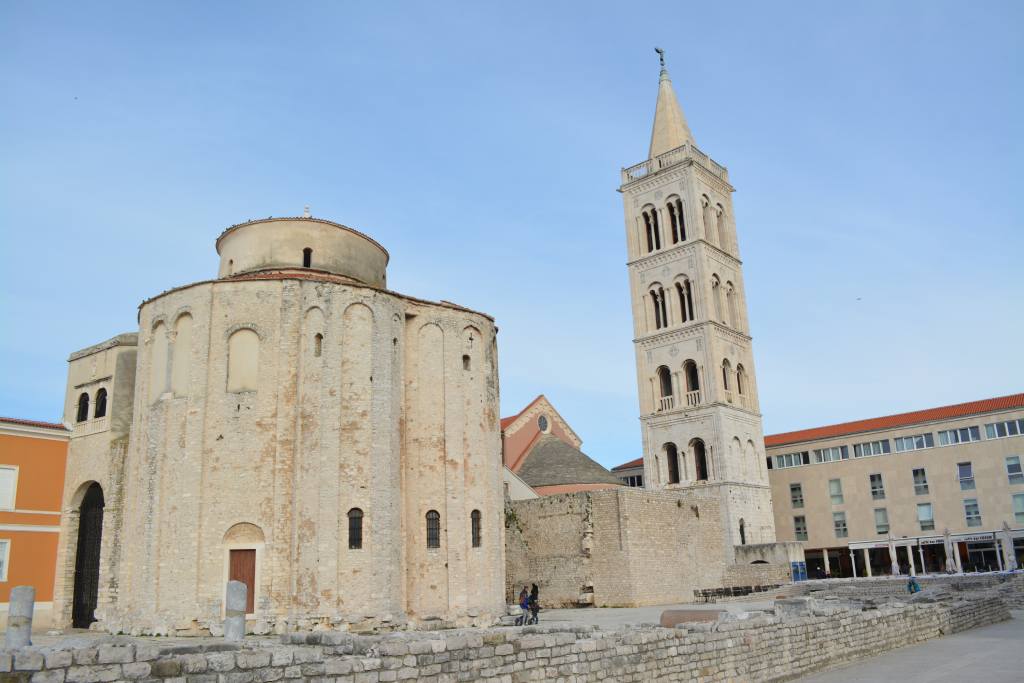
Entirely surrounded by the Adriatic Sea, Zadar may not be huge, but it shines with character.
Perched on a slender peninsula between the Adriatic and the mountains of Velebit, Zadar feels both ancient and alive — a city where the rhythm of waves replaces time, and where the sound of the sea organ seems to breathe with the tide. Once a proud Illyrian and Roman settlement, then a Venetian jewel, Zadar has endured sieges, earthquakes, empires, and wars. Yet, every dawn here still begins with the same slow glow over the islands, and every evening still ends in a sunset so striking that Alfred Hitchcock called it “the most beautiful in the world.”
Walking through the polished marble streets of the old town is like leafing through an illuminated manuscript. Roman columns lean beside early Christian churches; Byzantine mosaics rest under bell towers; Venetian loggias open to modern cafés where conversations flow in every language. The city’s heartbeat lies in its balance — sacred and secular, calm and curious, ancient and utterly modern. Stand at the edge of the Riva promenade and you’ll hear the Sea Organ play its soft, haunting song, while the “Greeting to the Sun” dances in light beneath your feet. Here, Zadar doesn’t just preserve history — it performs it, in light and sound, every single day.
Beyond its walls, the Adriatic opens like a vast blue promise. Ferries glide toward the islands of Ugljan, Dugi Otok, and Pašman; small boats shimmer in the golden evening; fishermen mend their nets in silence. Inland, the scent of pine and sage drifts down from Velebit, where trails lead to stone villages and forgotten chapels. Between sea and mountain, between ruin and renewal, Zadar lives in the pause — that gentle space where past and present meet and take a breath together.
📍 Where it lies: Central Dalmatia, on a peninsula stretching into the Adriatic Sea, about halfway between Split and Rijeka.
🚶 Wander: Poljana Square, St. Donatus Church, the Roman Forum, and the Riva promenade with the Sea Organ and Greeting to the Sun.
⛪ Sacred corners: Cathedral of St. Anastasia, Church of St. Chrysogonus, and the Franciscan Monastery with its serene cloister.
💧 Hidden gems: The Archaeological Museum, Five Wells Square, and the calm beaches of Kolovare and Puntamika.
🌅 Putokoza tip: Don’t rush the sunset — stay by the sea organ as the sky deepens into rose and indigo. In Zadar, even the light moves slowly.