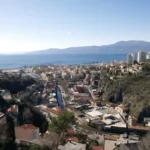
The sharp bite of the Bora wind cuts through the air, its chill weaving around like an invisible thread pulling you into the heart of Bakar. The echo of distant church bells reverberates across the bay, a call that is both ancient and welcoming. Resting like a pearl in the arms of a hill at the heart of the bay that shares its name, Bakar is a place both scenic and timeless.
Though at a glance it seems tiny, one of the elder northern Adriatic towns has plenty to offer, especially to wanderers like me seeking the traces of the past. A place built amphitheatrically on a hill features a historic core designated a cultural monument in 1968. This designation is well-deserved, as the town is home to structures dating back to the Middle Ages, highlighting its status as one of the oldest towns in the Northern Adriatic.
In addition to having the historic nucleus and a tiny port, the place where the Mediterranean Sea deepened into the European mainland is right at the epicentre of the Bora Wind. The best time to do that is during the winter, when there is only a breeze, not in the summer. While winter offers a serene, whispering solitude with just the crisp air rustling through the streets, the summer bustle contrasts sharply, filling Bakar with lively energy and chatter. As I wander up its cobbled streets, I feel the rhythm of a town that has learned to live slowly, nestled between the tide and the hill.

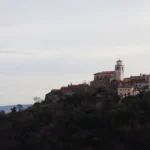
The steps lead past small arched doors that once hid cellars, to the Citadel that still guards the view, and to St. Andrew’s Church, whose bell tower has watched centuries pass unshaken. The Turkish House stands nearby, a soft oriental curve in a town of corners, while the pond of Jaz mirrors the sky like a quiet heart of the place. Down by the shore, the stone promenade invites a peaceful walk. Even the old tunnel under the bay, once part of Bakar’s industrial port, now rests as a silent memory of another rhythm, another time. Bakar is not a place to rush through. It is a place to listen, to breathe, to capture between the whisper of stone and the hush of the sea.
5 best things to do in Bakar
If you’re looking to slow down and immerse yourself in the charm of a coastal gem, Bakar Old City Core is the place to be. Nestled in a bay on the northern Adriatic, this quaint town is a living testament to history and heritage. Perched like a pearl on a hill in the centre of the bay, Bakar may seem small at first glance, but it is full of ancient features. Below are the top 5 things to do while visiting Bakar, tailored for different types of travelers to enhance your experience: the history enthusiasts, photographers, families, and those simply seeking tranquility will all find something that resonates here.
Stroll the old city core streets and mention the tiny circular house entrances
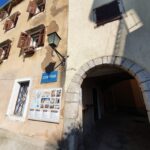
One of the first things to do in Bakar is wander the cobbled streets of the Old Town. All of my favourite attractions are located there. Beset by the remains of the town gates and remnants of the walls used to protect this historic city, you’ll get to enjoy beautiful architecture dating as far back as the early Middle Ages. One of the oldest towns in the northern Adriatic, it offers plenty to explore for those who, like me, seek the whispers of the past. The town’s amphitheatrical layout creates a picture-perfect historic core, which has been protected as a cultural monument since 1968. Its timeless charm lies in the way stone, sea and wind intertwine, especially when the Bora blows through its alleys, carrying the scent of pine and salt. As you meander past the small, circular doors that once led to hidden cellars, the cool touch of worn stone and the faint aroma of freshly baked bread waft through the air, creating an immersive sensory experience. Winter is when the wind truly comes alive, while in summer it softens into a gentle breath that cools the air above the bay.

There’s a fantastic view from the upper town streets. Simultaneously, the small square is a regular tourist hotspot, making it an ideal place to enjoy your holiday. Keep an eye out for Roman House, the Citadel, the Turkish house and the bell tower, to make the original town postcard. We’ve walked all over the Old Town of Bakar and love its artistic vibe. While walking through the Upper Old Town, one could notice manytiny circular entrancesto cellars, basements, and living spaces. This circular door is very picturesque, making it a real work of art.
Admire St. Andrew the Apostle church
The largest church in Bakar was proclaimed as a parish on 28th August 1853. It is also the third-largest church in Croatia, after the Cathedrals in Zagreb and Đakovo. The building, dating back to the 12th century, is assumed to be the oldest on this site. It was severely damaged by the 1323 earthquake. The church dedicated to the Holy Trinity changed its protector, while after restoration, the city’s patron became St Andrew.
Underneath the parish is a crypt with 85 graves, divided into two sections. The vault is not thoroughly researched, which would surely bring more information about the church’s time. Still, it is supposed to have indeed belonged to an older building. The emblems are from the 18th and 19th centuries, and some graves have no inscription.

There is a bell tower dating back to 1710, next to the church. The fact to mention is that the bell tower remained intact and was not damaged by an earthquake. Though the bell tower seems very vibrant when seen up close, this city symbol is most photogenic when captured from above.
Turkish House
Within the city’s medieval walls, next to the largest square in the old town, is the Turkish House. One of the best-known and most attractive houses for visitors, it was built by an unknown builder. Although its exact construction date remains a mystery, there are two intriguing legends about its origin as a house without ‘corners’. With its distinctive oriental design, the result of reconstruction and expansion in the late 17th century, the Turkish House continues to captivate visitors. As you explore, consider seeking out rumoured hidden symbols or unique architectural features tied to these ancient tales—transforming a simple visit into an adventurous scavenger hunt. Who knows, you might uncover a piece of history all your own.

The uniqueness and beauty of the Turkish house draw the attention of many photographers and painters. It is a common theme in paintings, and therefore, some call it the home of painters. A place is distinctive for its shape, which resembles a watchtower.
Marvel The Zrinski – Frankopan Citadel in Bakar
Standing at the top of the hill is the citadel (Bakar’s Castle), one of the most historic town buildings. This imposing medieval structure rises about 50 meters above the bay, and archaeological research indicates it dates back to the Bronze and Iron Ages, when the Liburnian tribe inhabited the area. While the exact construction date is unknown, the castle began to take its present form in the early 16th century, responding to threats from the Ottomans. Its fortifications were further reinforced, as recorded in the Glagolitic Inscription from 1530 on the stone gate entrance. During the 16th and 17th centuries, it was owned by the noble Zrinski dukes, who were relatives of the Frankopans.
Take a look at the Romans’ House
One of the most impressive late Baroque buildings in Bakar is next to the castle and the parish church of St Andrew. Some would say this is the most marvellous building in the upper part of the town. The Roman House, reminiscent of similar ones along the Adriatic coast (Poreč), is characterised by a remarkable, monumental appearance in the neo-Renaissance style. The characteristics of construction reveal a high level of cultural sophistication among its builders. There is no constructor, and the first owner of this building. It is assumed to have been built as a convent in the 18th century and was the family Carina’s home for many years.
Bonus thing to do in Bakar: have a look at the historical water collection points
Bakar Bay is an interesting geological feature: a submerged karst valley that stretches parallel to the coast, running northwest-southeast. Bakar has always been a jewel with a water source. Unlike the many other medievals, the place is particular to its position above the hill. This made him historically significant and enabled the site to serve as a place of habitation for its inhabitants.
Jaz
This natural phenomenon pond located downtown next to the sea has become one of the most recognisable symbols of Bakar. Since the city belonged to the Frankopans, Jaz is mentioned as a water-collection point, drawing from several rich Bakar water sources that flow underground through the surrounding hills.
The water coming from the source is cold and pure, and it does not dry up even during extreme heat and drought. At the end of the 20th century, people began trout cultivation, so the pond now has its own inhabitants. The pond is very picturesque and makes an excellent subject.
Perilo
As part of the water source, this cultural and historical monument stands on the shore, a silent witness to the city’s history. Perilo was a site for washing clothing, but also a place where the latest city news was retold.

Unlike the many other medievals in the area, Bakar had a freshwater source, so this place was so popular that many of Bakar’s families used it for laundry. Laundry was first done at home by hand washing on a wooden washboard. A domestic soap was used for washing. The laundry was placed into the bucket and carried to the town’s winding streets to Perilo, where it was rinsed.
There are many old postcards of hearing witnesses that show the upgrades and updates to Perilo over the years. Let’s take some of the images and transform them into an art postcard.
The other things to do while in Bakar
Every place has its features. So the Bakar also does it. Here are some things not to miss while in Bakar.
Stroll around the old Bakar cemetery.
Don’t be alarmed at the name. This cemetery is nowhere near as creepy as it sounds. It is a relaxing, sacred place dedicated mostly to sailors. The old cemetery located just next to the Church of the Mother of God of the Port used to serve as the central county cemetery. This is evident in many gravestones built into the church’s interior walls, many of which have artistic value. Stroll it in peace, and meet some historical Bakar family names.
The church of Holy Cross
Located among the old town’s houses and streets, well-hidden from curious glances, this is a tiny building that will not leave you indifferent. After the great earthquake in 1750, the noble family Carina helped rebuild the chapel (which had been dedicated to St. Peter). The church, not more significant than the several houses surrounding it, has stood there since 1764. The building is peculiar due to its main door being built in the east, and the altar in the west, which is the reverse of the Catholic Church’s usual practice. The building has preserved its medieval appearance.

Entering into its simple yet solemn interior results in a touch of mysticism and spiritual intimacy. So that one can feel the breath of old times in this church, where the altar remained positioned as it once was. A priest carried out the liturgy with his back to the faithful.
The Church of the Mother of God of the port
Church of Mother of God of the Port, lying on the north-east side of the Bakar town, outside of the old medieval city walls, next to the sea. They are below. Once, it was a port. The building’s name is dedicated to sailors and all those involved in navigation. This church was, therefore, a votive shrine for sailors from these regions.
The oldest inscription about the church is a Glagolitic document dating from 1445. It suggests that the church had been founded earlier. The building was restored, upgraded, and expanded several times. In 1641, the famous Croatian noble family, the Zrinski, who at the time governed the town of Bakar, had the church built.
Saint Margaret’s Church
Located on the south side of the town is St. Margaret’s Church, the patroness of Bakar. The Church of St. Margaret was built in 1658 with the donation of Governor Petar Zrinski. However, about two hundred years earlier, in 1450, Martin Frankopan ordered the building of a chapel in St. Margaret’s honour, and the governor PetarZrinski transformed the chapel into today’s church.
The most valuable piece of art in the building is a canvas presenting St. Margaret, an artwork of the Slovenian painter Valentin Metzinger.
Sea promenade walk and a sea tunnel
It’s virtually impossible to get lost in Bakar, which is ideal for those who enjoy wandering at their own pace, seeing what they can find along the way. But one of the things to do is a seaside walk. After arriving at Bakar, a beautiful stone pier makes the long promenade ideal for a walk, offering a chance to rest from the daily grind.
The thing that might be particularly mentioned in the southern part of the town is a tunnel under the sea that connects both parts of the bay. The tunnel was built when Bakar was an industrial port for the production of coke (coal, fuel). Unfortunately, today the tunnel is closed, but who knows, maybe someday it will become a tourist sight.
Getting to Bakar
📍 Where it lies: 13 km from Rijeka, easily reached by car or local bus.
🚗 By Car. ~15 minutes from Rijeka.
🚌 By Bus. Regular public lines connect Rijeka and Bakar.
🚶 Wander: cobbled streets of the old core, the Citadel of Zrinski–Frankopan, Turkish House, and Roman House.
⛪ Sacred corners: St. Andrew’s Church, St. Margaret’s, Holy Cross, and the Church of Our Lady of the Port.
💧 Hidden gems: Jaz Pond and Perilo – ancient freshwater spots turned into local landmarks.
🌊 Take it slow: walk the seaside promenade, enjoy views over the bay, explore nearby trails toward Gorski Kotar.
🅿️ Practical: parking along the waterfront, tourist info point by the sea.